
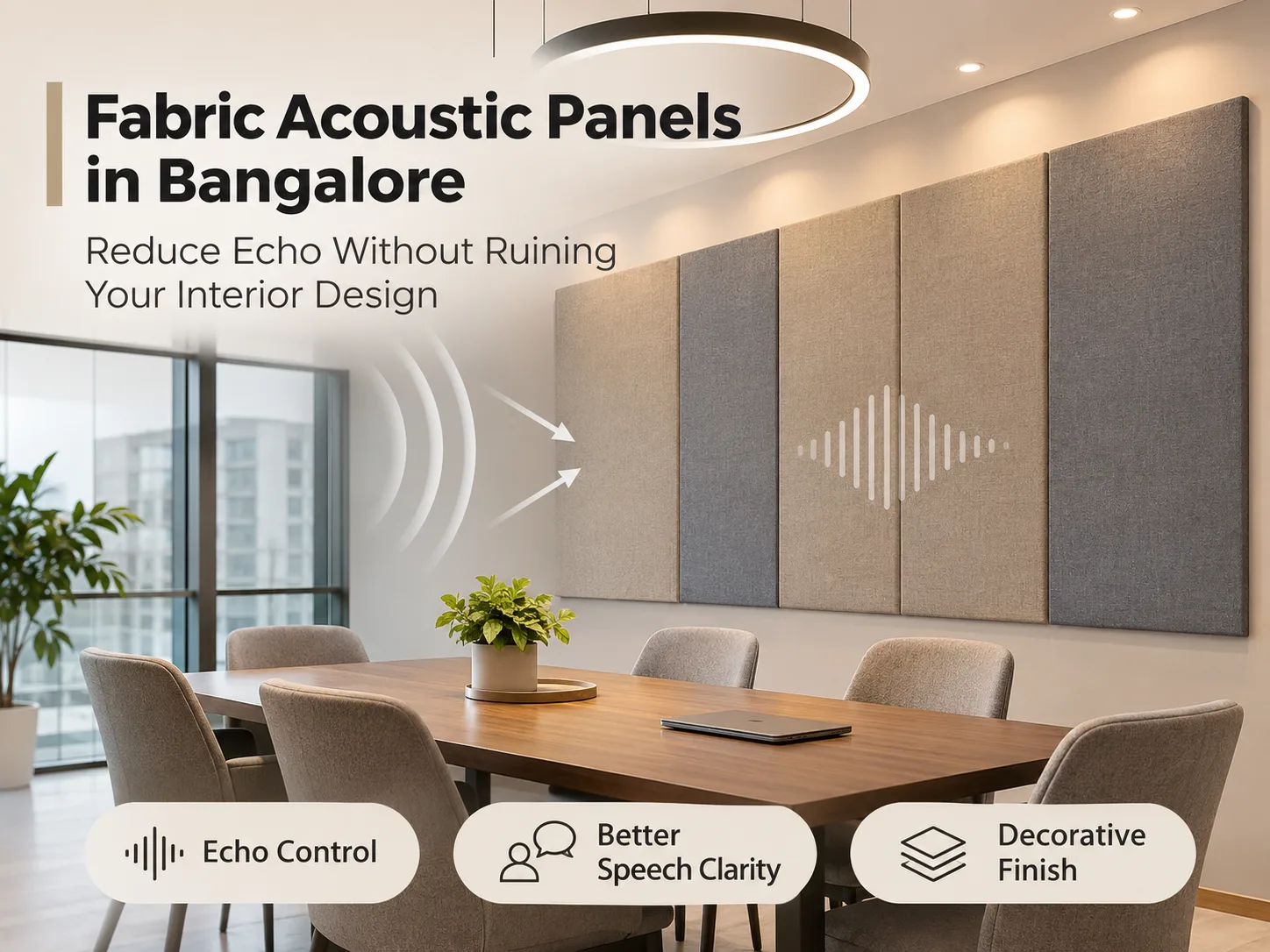

A beautiful room should not only look good—it should sound good too.
Glass walls, marble floors, concrete ceilings and modern open layouts may create stunning interiors, but they can also make sound bounce around the room. The result is excessive echo, poor speech clarity and an uncomfortable acoustic environment.
This is where fabric acoustic panels in Bangalore can make a major difference.
Unlike acoustic treatments that look overly technical or industrial, fabric-wrapped panels can be designed as part of the interior itself. They can blend into a wall, become a feature element or complement the colours, furniture and architectural language of the space.
Whether you are designing an office, conference room, home theatre, recording studio, restaurant or residence, the goal is the same:
Control unwanted reflections without compromising the interior design.
This guide explains how fabric acoustic panels work, where they should be installed and how to integrate them naturally into your space.
Quick Answer: Do Fabric Acoustic Panels Reduce Echo?
Yes. Fabric-wrapped acoustic panels reduce echo by absorbing reflected sound before it repeatedly bounces between hard surfaces. They are commonly installed on walls and ceilings in offices, conference rooms, home theatres, studios and residential spaces.
For the best result, panel thickness, acoustic material, placement and total coverage should be selected according to the room rather than simply covering random walls.
Why Do Modern Interiors Have So Much Echo?
Walk into an empty modern apartment, meeting room or office and clap your hands.
If you hear the sound continue after the clap, the room has noticeable reverberation.
The main reason is usually the amount of hard, reflective material in the room.
Common reflective surfaces include:
- Glass partitions
- Marble flooring
- Granite
- Concrete
- Gypsum walls and ceilings
- Wooden laminates
- Large windows
- Metal surfaces
- Minimalist furniture
Instead of absorbing sound energy, these surfaces reflect much of it back into the room.
When multiple reflections overlap, conversations become less clear and the room begins to feel louder.
This is particularly noticeable in modern Bangalore offices and residences where glass, stone, open ceilings and minimalist interiors are increasingly common.
Real-World Example
Imagine a conference room with:
- Glass walls on two sides
- A large meeting table
- Hard flooring
- Gypsum ceiling
- Minimal soft furniture
During a meeting, voices reflect between these surfaces.
Someone sitting across the table may hear both the direct voice and multiple delayed reflections. This reduces speech clarity and makes video meetings more tiring.
Adding properly positioned conference room acoustic panels can absorb part of these reflections and create a more controlled acoustic environment.
Pro Tip: Don’t automatically assume that more panels mean better acoustics. Correct placement and sufficient coverage matter more than randomly filling walls.

What Are Fabric-Wrapped Acoustic Panels?
Fabric-wrapped acoustic panels are sound-absorbing panels finished with acoustically suitable fabric.
A typical panel consists of:
- An acoustic absorption core
- A supporting frame or edge structure
- Acoustically suitable fabric
- A mounting system
The fabric provides the visual finish, while the material behind it performs most of the sound absorption.
This makes the system particularly useful when architects and interior designers want acoustic treatment without making the space look like a recording studio.
Panels can be manufactured in different:
- Sizes
- Thicknesses
- Shapes
- Fabric colours
- Patterns
- Edge details
- Layouts
They can therefore become an intentional part of the interior.
How Do Fabric Acoustic Panels Reduce Echo?
Sound travels through a room until it interacts with a surface.
Hard surfaces reflect much of that sound.
An acoustic absorber works differently.
When sound reaches an appropriately designed porous acoustic panel, part of the sound energy enters the material instead of being strongly reflected back into the room.
This reduces the strength of repeated reflections.
Before Acoustic Treatment
Voice → Wall → Reflection → Glass → Reflection → Ceiling → More Reflections
After Acoustic Treatment
Voice → Acoustic Panel → Sound Energy Absorbed → Weaker Reflections
The practical result can be:
- Reduced reverberation
- Better speech clarity
- More comfortable conversations
- Better meeting-room communication
- Improved recording conditions
- Better perceived sound quality
- Less acoustic fatigue
The goal is generally not to remove every reflection.
A well-designed room should retain an appropriate amount of acoustic energy while controlling problematic reflections.
Fabric Acoustic Panels vs Soundproofing: Know the Difference
This is one of the most important distinctions to understand.
Acoustic treatment and soundproofing are not the same thing.
Fabric acoustic panels primarily help control sound inside a room.
Soundproofing is intended to reduce sound transmission between different spaces.
| Problem | Typical Approach |
|---|---|
| Echo inside a conference room | Acoustic absorption |
| Poor speech clarity | Acoustic treatment |
| Home theatre reflections | Acoustic treatment |
| Recording-room reverberation | Acoustic treatment |
| Traffic noise entering a room | Sound isolation |
| Conversation passing through a wall | Sound isolation |
| Noise from one apartment entering another | Soundproofing / isolation |
If your problem is echo, sound absorption panels in Bangalore may be appropriate.
If sound is passing through walls, doors, windows, floors or ceilings, the construction itself may require investigation.
Fabric Acoustic Panels in Bangalore: Where Should You Use Them?
Fabric panels are versatile enough to work across residential, commercial and professional environments.
1. Office Acoustic Wall Panels
Modern offices often combine glass partitions, exposed ceilings, open workstations and hard flooring.
That combination can create distracting reflections.
Office acoustic wall panels can be incorporated into:
- Open workspaces
- Meeting rooms
- Boardrooms
- Director cabins
- Collaboration zones
- Reception areas
- Training rooms
- Cafeterias
For offices, acoustic treatment should consider both overall reverberation and how different areas are used.
A meeting room needs different acoustic control from an open collaboration zone.
2. Conference Room Acoustic Panels
Conference rooms depend heavily on speech intelligibility.
Excessive reverberation can make:
- Conversations harder to follow
- Video calls less clear
- Microphones capture more room sound
- Participants repeat themselves
- Long meetings more tiring
Strategically placed conference room acoustic panels can improve the acoustic conditions without interfering with screens, furniture, lighting or branding.
Panels can even be integrated into the interior colour scheme or arranged as architectural features.
3. Home Theatre Acoustic Panels
A home theatre is not simply a room containing speakers.
The room itself influences what you hear.
Sound from the speakers interacts with:
- Side walls
- Front wall
- Rear wall
- Ceiling
- Floor
- Furniture
Uncontrolled reflections can reduce dialogue clarity and stereo imaging.
A home theatre treatment strategy may include:
- Front-wall absorption
- First-reflection treatment
- Rear-wall absorption or diffusion
- Ceiling absorption
- Low-frequency treatment
Home theatre acoustic panels can be fabric-finished to complement dark theatre interiors, wooden elements or luxury interior themes.
Pro Tip: Do not cover every surface of a home theatre with absorption. Over-treatment can make a room unnaturally dry. The acoustic design should balance absorption, reflection and, where appropriate, diffusion.
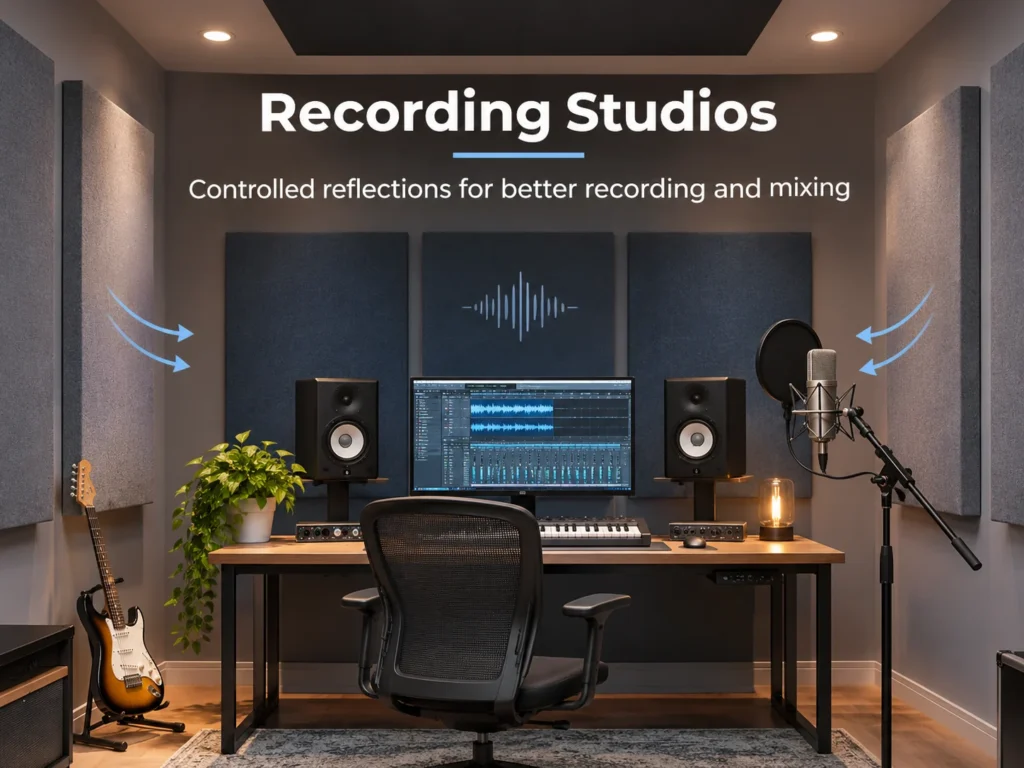
4. Recording Studio Acoustic Panels
Recording spaces require controlled reflections because microphones capture both the source and the room.
Poor room acoustics can result in recordings with:
- Excessive room sound
- Flutter echo
- Poor vocal clarity
- Uncontrolled reflections
- Difficult monitoring conditions
Recording studio acoustic panels can help create a more controlled recording environment.
Studios may also require bass absorption and diffusion depending on their dimensions and intended use.
5. Residential Interiors
Acoustic treatment isn’t limited to studios and offices.
Modern homes increasingly use large areas of:
- Marble
- Glass
- High ceilings
- Double-height spaces
- Open-plan living areas
These spaces can become noticeably reverberant.
Decorative fabric panels can be integrated behind sofas, around entertainment areas, along staircase walls or within architectural wall compositions.
The result can look more like an interior feature than technical acoustic equipment.
6. Restaurants, Cafés and Hospitality Spaces
A busy restaurant can become uncomfortable when conversations, music, kitchen noise and furniture movement all reflect through the same room.
Acoustic absorption can be incorporated into selected walls and ceilings while maintaining the intended interior style.
The objective isn’t to make the restaurant silent.
It is to create a more comfortable acoustic environment where guests can communicate without constantly raising their voices.
Decorative Acoustic Panels: Acoustics Without Sacrificing Design
One of the biggest concerns clients have is:
“Will acoustic panels ruin my interior?”
They shouldn’t.
Modern decorative acoustic panels can be treated as an architectural finish rather than something added after the interior is complete.
For example, fabric panels can be designed as:
Geometric Wall Features
Rectangular or square panels can be arranged into clean patterns that create visual rhythm.
Full-Wall Acoustic Treatment
Panels can be installed across larger wall areas to create a seamless upholstered appearance.
Colour-Matched Panels
Fabric can be selected to complement furniture, flooring, curtains and other interior finishes.
Contrasting Feature Walls
Instead of hiding the acoustic treatment, designers can deliberately make it a visual focal point.
Integrated Architectural Panels
Acoustic panels can be coordinated with:
- Wooden battens
- Lighting
- AV systems
- Wall finishes
- Branding
- Furniture
- Interior colour palettes
This is why acoustic planning works best when it starts during the interior design stage, rather than after the project is finished.
How to Choose Fabric Acoustic Panels
Do not choose panels only because they look attractive.
Consider these factors.
1. Understand the Acoustic Problem
First determine whether the issue is:
- Excessive echo
- Poor speech clarity
- Speaker reflections
- Recording-room reflections
- Low-frequency problems
- Sound transmission
Different problems require different solutions.
2. Measure the Room
Room dimensions influence acoustic behaviour.
Record:
- Length
- Width
- Height
- Wall construction
- Ceiling type
- Flooring
- Glass area
- Furniture
- Room use
These details help determine how much treatment may be required.
3. Consider Panel Thickness
Panel thickness affects acoustic performance.
A very thin decorative layer should not automatically be assumed to perform like a deeper acoustic absorber.
The appropriate thickness depends on the frequencies and acoustic issue being addressed.
4. Check Acoustic Performance Data
When comparing acoustic products, ask for relevant absorption performance information rather than judging the product by appearance alone.
Depending on the product and project, measurements such as absorption coefficients or NRC may be useful for comparing materials.
But a high-performing panel still needs appropriate placement and coverage.
5. Choose the Fabric Carefully
The outer fabric should support the acoustic function of the panel.
A visually attractive but poorly selected covering can affect how sound reaches the absorber behind it.
Fabric selection should therefore consider both:
Acoustic suitability + Interior aesthetics
6. Plan the Correct Coverage
Installing two small panels in a highly reverberant hall may make little noticeable difference.
Coverage should relate to:
- Room volume
- Existing absorption
- Surface materials
- Intended room use
- Acoustic target
This is where professional acoustic design becomes valuable.
7. Decide the Right Placement
Random panel placement is rarely the best strategy.
Panels may need to be positioned based on:
- Reflection paths
- Speaker locations
- Listener positions
- Room geometry
- Furniture layout
- Architectural restrictions
The right position depends heavily on how the room is used.

Step-by-Step Strategy to Reduce Echo Without Ruining Your Interior
Step 1 — Identify the Problem
Determine where the echo is most noticeable and when it occurs.
Step 2 — Study the Room
Evaluate dimensions, ceiling height and reflective surfaces.
Step 3 — Define the Acoustic Goal
A conference room, office and home theatre should not have identical acoustic targets.
Step 4 — Estimate the Required Absorption
Determine approximately how much additional absorption is needed.
Step 5 — Select the Acoustic System
Choose appropriate panel construction, thickness and mounting method.
Step 6 — Coordinate With the Interior Design
Select colours, dimensions and layouts that complement the architecture.
Step 7 — Determine Panel Locations
Place treatment where it will provide useful acoustic control rather than simply where there is empty wall space.
Step 8 — Install and Review
After installation, assess whether the room meets the intended acoustic objective.
For critical spaces, acoustic measurements can provide more objective verification.
Common Mistakes When Installing Acoustic Panels
Mistake 1: Buying Panels Only for Their Appearance
A decorative panel is not automatically an effective acoustic absorber.
Always consider its acoustic construction and available performance information.
Mistake 2: Installing Too Little Treatment
A few panels may not sufficiently change a large reverberant room.
Treatment quantity should relate to the room.
Mistake 3: Treating Only One Random Wall
Acoustic reflections occur throughout the space.
Placement should follow the room’s acoustic behaviour.
Mistake 4: Confusing Acoustic Panels With Soundproofing
Wall panels generally cannot solve major sound leakage through walls, windows, ceilings or doors.
Mistake 5: Ignoring Low Frequencies
Standard wall absorbers may not adequately solve significant bass problems.
Dedicated low-frequency treatment may be necessary.
Mistake 6: Treating Acoustics After Completing the Interior
Waiting until everything is installed can restrict panel locations, thicknesses and design possibilities.
The better approach is:
Architecture + Interior Design + Acoustics + AV Planning
when the project requires all four.
Custom Acoustic Panels Bangalore: When Should You Go Custom?
Off-the-shelf panels may work for straightforward projects.
But custom acoustic panels in Bangalore become valuable when a project has specific architectural or acoustic requirements.
Customisation may include:
- Panel dimensions
- Thickness
- Fabric colour
- Fabric texture
- Geometric layouts
- Wall-to-wall systems
- Ceiling integration
- Branding integration
- Edge detailing
- Custom mounting methods
For architect-led projects, this makes it easier to coordinate acoustic treatment with the overall design language.
Instead of asking:
“Where can we hide the acoustic panels?”
the better question becomes:
“How can the acoustic treatment become part of the interior?”
How Much Do Fabric Acoustic Panels Cost in Bangalore?
There is no single correct price because projects vary significantly.
Cost can depend on:
- Acoustic material
- Panel thickness
- Panel dimensions
- Fabric selection
- Total quantity
- Customisation
- Edge and frame construction
- Mounting requirements
- Site conditions
- Installation complexity
For this reason, comparing products only on a per-square-foot price can be misleading.
A better comparison considers:
Acoustic performance + build quality + finish + design + installation + overall project result.
Do You Need an Acoustic Consultant?
Not every room requires an extensive acoustic study.
But professional acoustic input becomes more valuable for:
- Home theatres
- Recording studios
- Auditoriums
- Boardrooms
- Large offices
- Conference facilities
- Restaurants
- Houses of worship
- Critical listening rooms
- Premium residential projects
An acoustic consultant can evaluate the room, define treatment requirements and coordinate solutions with architects, interior designers and AV teams.
This reduces the risk of buying acoustic products first and trying to solve the room later.
Fabric Acoustic Panels vs PET Acoustic Panels
Both products can be useful, but they serve different design requirements.
| Feature | Fabric-Wrapped Panels | PET Panels |
|---|---|---|
| Appearance | Soft, premium upholstered finish | Contemporary architectural finish |
| Colour Options | Extensive fabric selection | Multiple PET colours |
| Customisation | Very high | High |
| Wall Application | Excellent | Excellent |
| Office Use | Excellent | Excellent |
| Home Theatre | Excellent | Application-dependent |
| Design Flexibility | Very high | Very high |
| Acoustic Performance | Depends on construction | Depends on product construction |
The best choice depends on the project rather than one material being universally superior.
In some spaces, combining multiple acoustic solutions can provide better design flexibility.
Frequently Asked Questions
1. Do fabric acoustic panels really reduce echo?
Yes. Properly designed fabric-wrapped acoustic panels absorb part of the sound energy that would otherwise reflect from hard surfaces. This can reduce reverberation and improve speech clarity.
2. Where should acoustic panels be placed?
Placement depends on room geometry and use. Common locations include reflection areas on walls and ceilings. Home theatres and studios require more specific placement based on speakers, listeners and room dimensions.
3. Are acoustic panels the same as soundproofing?
No. Acoustic panels primarily control reflections within a room. Soundproofing addresses sound travelling from one room or building area to another.
4. Are fabric acoustic panels suitable for offices?
Yes. Office acoustic wall panels can help manage reverberation in meeting rooms, boardrooms, open offices, cabins and collaboration spaces.
5. Can acoustic panels match my interior design?
Yes. Fabric-wrapped panels can be customised in different colours, sizes, layouts and finishes so they can blend into or intentionally complement the interior.
6. Are fabric panels suitable for home theatres?
Yes. Home theatre acoustic panels are commonly used to control reflections. Depending on the room, additional bass absorption and diffusion may also be required.
7. What thickness should an acoustic panel be?
There is no universal ideal thickness. It depends on the acoustic problem and frequencies being addressed. Deeper absorbers can generally provide useful absorption over a broader frequency range than very thin absorbers, assuming suitable construction.
8. How many acoustic panels does a room need?
It depends on room dimensions, volume, surface materials, existing furnishings and the target acoustic condition. Panel quantity should ideally be determined from the room rather than using a fixed number.
9. Can fabric acoustic panels be installed on ceilings?
Yes. Acoustic absorbers can also be integrated into ceilings when wall area is limited or additional absorption is required.
10. Where can I get custom fabric acoustic panels in Bangalore?
BEL Acoustics provides acoustic design and treatment solutions for spaces such as offices, conference rooms, home theatres, recording environments and residential interiors in Bengaluru. The appropriate panel system should be selected after understanding the room and its acoustic requirements.
- Acoustic Panels Bangalore
- PET Acoustic Panels Bangalore
- Home Theatre Acoustics Bangalore
- Office Acoustic Solutions Bangalore
- Apartment Soundproofing in Bangalore
- Bass Absorbers / Low-Frequency Absorption
- Acoustic Diffusers
- Professional Acoustic Design
- Contact BEL Acoustics
Better Interiors Don’t Have to Sound Bad
Modern architecture gives us beautiful glass, stone, wood and open spaces.
But these materials can also create challenging acoustics.
The solution does not have to be choosing between good acoustics and good interior design.
Properly designed fabric acoustic panels in Bangalore can reduce unwanted reflections while becoming part of the architecture itself.
The key is to avoid treating acoustic panels as decoration alone.
Understand the room. Identify the acoustic problem. Select the appropriate absorber. Position it correctly. Then integrate it into the interior.
That is how you create a space that looks refined and sounds comfortable.
Need an Acoustic Solution for Your Space in Bangalore?
BEL Acoustics designs and implements acoustic solutions for offices, conference rooms, home theatres, studios, residences and other architectural spaces.
From acoustic planning and custom manufacturing to supply and installation, the objective is to integrate acoustic performance with the interior—not fight against it.
Conclusion: Better Acoustics, Beautiful Interiors with BEL Acoustics
A beautifully designed space deserves equally comfortable acoustics. Whether it’s a modern office, luxury residence, home theatre, conference room or recording studio, excessive echo can affect sound clarity, communication and overall comfort.
Fabric acoustic panels in Bangalore offer an effective way to reduce echo while preserving the aesthetics of your interiors. With the right combination of sound absorption, panel placement, custom finishes and acoustic design, these panels can become a seamless part of your space.
At BEL Acoustics, we bring together acoustic engineering, interior design expertise and in-house manufacturing to create customised acoustic solutions that balance performance with aesthetics. From consultation and acoustic design to manufacturing, supply and installation, we help transform spaces into acoustically comfortable environments.
Transform Your Space with BEL Acoustics
Looking for custom fabric acoustic panels, decorative acoustic panels or professional acoustic treatment in Bangalore?
Let BEL Acoustics help you create a space where every sound feels right and every design detail matters.
Because great interiors shouldn’t just look beautiful. They should sound beautiful too.
Explore Our Acoustic Solutions: www.belacoustics.in
BEL Acoustics — Cut the Noise.
Website: belacoustics.in
Location: Bengaluru, Karnataka
Contact on: +91 97390 18885