


A room can look beautiful and still sound uncomfortable.
Too much echo, unclear conversations, booming bass, distracting office noise or poor music clarity can make even a premium interior unpleasant to use.
That is where professional acoustic panels Bangalore solutions become important.
But choosing an acoustic panel is not simply about covering a wall with foam or fabric. Different acoustic problems require different treatments.
A meeting room struggling with speech echo needs a different solution from a home theatre with heavy bass. A recording studio needs greater control than a restaurant or office lobby. Best acoustic panels in Bangalore for offices, home theatres and studios
In this guide, we explain how fabric acoustic panels, PET acoustic panels, bass absorbers and acoustic diffusers work, where each should be used, and how to choose the right acoustic treatment in Bangalore.
Quick Answer: Which Acoustic Panel Does Your Room Need?
For general echo and speech control, use fabric or PET acoustic panels. For excessive low-frequency bass, use bass absorbers or bass traps. For studios, music rooms and larger critical listening spaces, acoustic diffusers help scatter sound rather than absorb everything. Most well-designed rooms use a combination based on acoustic measurements and room usage.
What Is Acoustic Comfort in Interior Design?
Acoustic comfort interior design means designing a space so that unwanted sound, echo and reverberation are controlled without compromising the appearance or function of the room.
Good acoustic comfort allows people to:
- Hear conversations clearly
- Work with fewer distractions
- Enjoy music and movies accurately
- Conduct meetings without excessive echo
- Record cleaner audio
- Relax without constant sound reflections
- Maintain better speech privacy
- Experience a more premium interior environment
Hard surfaces such as glass, concrete, marble, gypsum, wooden laminates and large windows reflect sound.
When too many reflective surfaces are present, sound continues bouncing around the room instead of fading naturally.
This creates reverberation.
The WELL Building Standard notes that high reverberation can increase ambient noise and reduce speech intelligibility. Acoustic absorption on walls, ceilings and other surfaces can help manage this problem.
Why Do Modern Bangalore Interiors Need Acoustic Treatment?
Modern architecture often uses:
- Glass partitions
- Large windows
- Marble or granite flooring
- Exposed concrete
- Minimal furniture
- Open ceilings
- Hard wooden finishes
- Large open-plan layouts
These surfaces may look excellent but provide limited sound absorption.
As a result, offices, apartments, restaurants, studios and entertainment spaces may experience excessive reverberation.
Noise itself is also more than an inconvenience. WHO identifies excessive environmental noise as a factor associated with annoyance, sleep disturbance and other health impacts.
Professional acoustic treatment Bangalore services therefore focus not only on reducing noise but on creating the right acoustic environment for the activity taking place inside the room.
Types of Acoustic Panels in Bangalore
There is no single acoustic product that solves every sound problem.
Here are the four major treatment types you should understand.
1. Fabric Acoustic Panels Bangalore
Fabric acoustic panels are among the most versatile solutions for controlling mid- and high-frequency reflections.
They typically contain an acoustically absorptive core covered with an acoustically transparent fabric.
Best suited for:
- Corporate offices
- Meeting rooms
- Conference rooms
- Home theatres
- Recording studios
- Restaurants
- Schools
- Auditoriums
- Podcast studios
- Residential interiors
What do fabric acoustic panels solve?
They primarily help reduce:
- Speech echo
- Flutter echo
- Excessive reverberation
- Harsh sound reflections
- Poor speech clarity
Why architects like fabric acoustic panels
Fabric panels can become part of the interior rather than looking like technical acoustic equipment.
They can be designed in:
- Different colours
- Custom sizes
- Geometric layouts
- Full-wall arrangements
- Decorative patterns
- Brand colour combinations
This makes fabric acoustic panels Bangalore particularly suitable for premium office and residential interiors.
Pro Tip
Do not select acoustic panels only based on colour or thickness.
Their placement, surface area, acoustic performance and distance from reflective boundaries can significantly influence the final result.
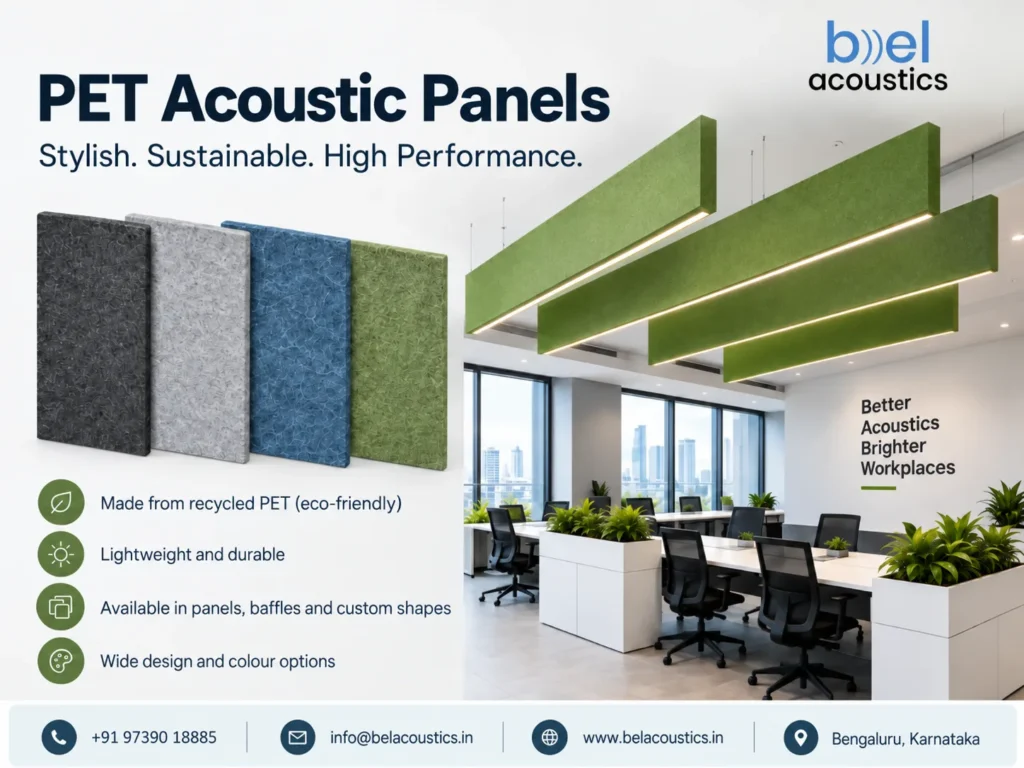
2. PET Acoustic Panels Bangalore
PET acoustic panels have become popular in modern commercial interiors because they can combine acoustic absorption with decorative design.
They are especially useful where designers want lightweight, clean-looking acoustic elements.
PET panels can be used as:
- Wall panels
- Ceiling baffles
- Hanging acoustic clouds
- Desk dividers
- Decorative geometric panels
- Suspended ceiling elements
- Acoustic partitions
Best applications
PET acoustic panels Bangalore are particularly useful for:
- Open offices
- Co-working spaces
- Cafés
- Reception areas
- Educational spaces
- Meeting rooms
- Call centres
- Collaborative workplaces
Why PET panels work well in offices
Consider a 50-person open office.
Employees are speaking on calls, conducting discussions and moving around throughout the day.
With hard floors, glass meeting rooms and exposed ceilings, sound reflects throughout the workplace.
Installing PET ceiling baffles and strategically positioned wall panels can help reduce those reflections and improve overall acoustic comfort.
Pro Tip
In an open office, treating only one wall may not provide sufficient improvement.
The ceiling often provides a large available surface for acoustic treatment without taking away usable floor space.
3. Bass Traps and Low-Frequency Absorbers Bangalore
Not every acoustic problem is an echo problem.
Sometimes the problem is bass.
Low-frequency sound behaves differently from speech and higher-frequency sound.
It can collect around room boundaries and corners, causing certain bass frequencies to sound much louder than others.
This is common in:
- Home theatres
- Music studios
- Recording rooms
- Mixing studios
- Jamming rooms
- Audiophile listening rooms
Standard thin wall panels alone may not adequately control these frequencies.
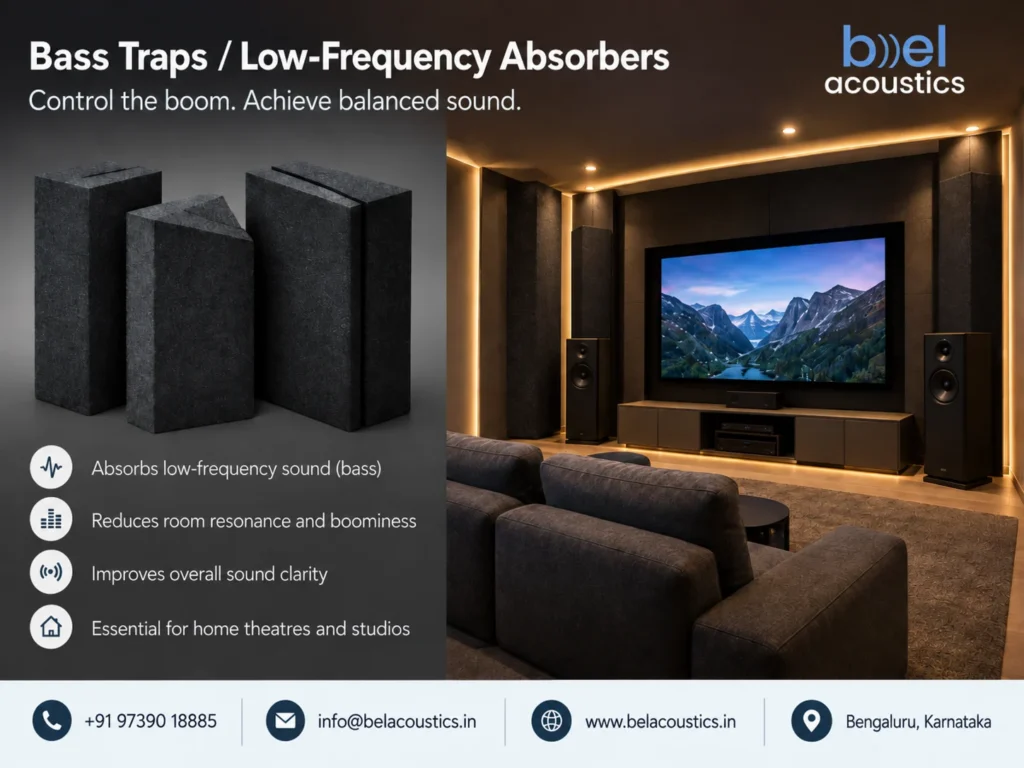
That is where bass traps Bangalore and dedicated low-frequency absorbers are required.
What Do Bass Traps Do?
Bass traps are designed to absorb excessive low-frequency energy.
They can help reduce:
- Boomy bass
- Uneven bass response
- Excessive resonance
- Bass buildup near corners
- Poor low-frequency clarity
Example
Imagine a home theatre where explosions sound extremely powerful near the rear wall but weak near the centre seating position.
Simply adding more decorative wall panels may not fix the problem.
Room dimensions, speaker position, listening position and low-frequency behaviour need to be assessed.
Dedicated bass treatment can then be incorporated where necessary.
Where Are Bass Absorbers Usually Installed?
Depending on the acoustic design, treatment may be positioned around:
- Room corners
- Front wall
- Rear wall
- Wall-ceiling junctions
- Speaker boundaries
Pro Tip
Avoid assuming that every corner automatically needs the same bass trap.
Low-frequency treatment should ideally be based on the room, speaker configuration and measured acoustic behaviour.
4. Acoustic Diffusers Bangalore
Absorption removes acoustic energy.
Diffusion redistributes it.
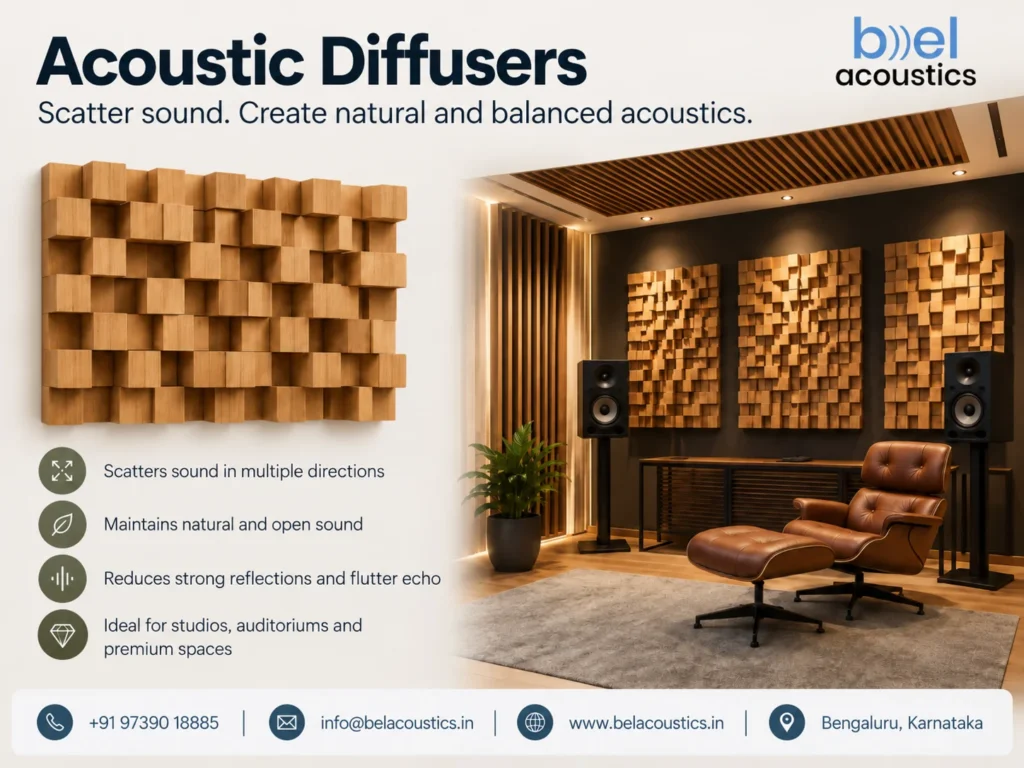
An acoustic diffuser uses carefully designed surface depths or geometric patterns to scatter reflected sound in multiple directions.
Instead of a strong reflection bouncing directly back toward the listener, the energy is spread more evenly through the room.
Where Are Acoustic Diffusers Used?
Acoustic diffusers Bangalore are commonly considered for:
- Recording studios
- Mixing rooms
- Mastering studios
- Premium home theatres
- Music rooms
- Auditoriums
- Critical listening rooms
They can be particularly useful where the objective is to maintain a sense of spaciousness while controlling strong reflections.
Absorption vs Diffusion
| Treatment | Main Purpose | Typical Applications |
|---|---|---|
| Fabric acoustic panel | Absorbs reflections | Office, theatre, studio, meeting room |
| PET acoustic panel | Absorbs reflections + design integration | Office, café, commercial interiors |
| Bass absorber | Controls low-frequency energy | Home theatre, music and recording rooms |
| Acoustic diffuser | Scatters reflected sound | Studios, theatres, critical listening spaces |
Important
A room should not necessarily contain maximum absorption.
Too much absorption can make a room sound unnaturally dull.
The objective is balanced acoustic control.
Acoustic Panels vs Soundproofing: They Are Not the Same
This is one of the biggest misunderstandings customers have.
Acoustic treatment
Acoustic treatment improves the sound quality inside a room.
It controls:
- Echo
- Reverberation
- Reflections
- Bass response
- Speech clarity
Soundproofing
Soundproofing reduces sound transmission between spaces.
For example:
- Traffic noise entering an apartment
- Music travelling into a neighbouring room
- Office conversations passing through walls
- Upstairs footsteps reaching the floor below
Therefore, adding acoustic panels to a wall does not automatically soundproof the wall.
If sound is travelling through walls, doors, ceilings or floors, the building assembly itself may need modification.
What Causes Poor Room Acoustics?
Before buying sound absorption panels Bangalore, understand what is creating the problem.
1. Too Many Reflective Surfaces
Glass, concrete, marble and painted walls reflect sound strongly.
2. Large Room Volume
Large spaces may allow sound to continue circulating for longer periods.
3. Parallel Walls
Strong reflections between parallel surfaces can produce flutter echo.
4. High Ceilings
Restaurants, offices and commercial spaces with high ceilings can develop significant reverberation.
5. Incorrect Speaker Placement
In theatres and studios, speaker placement can interact with room boundaries and create frequency problems.
6. Lack of Soft Furnishings
Minimalist interiors sometimes remove curtains, carpets and upholstered furniture that would otherwise contribute some absorption.
7. Wrong Acoustic Material
Installing thin decorative panels when the actual problem is low-frequency energy will produce limited results.
How to Choose the Right Acoustic Treatment in Bangalore
A professional acoustic solution should follow a process rather than start with product selection.
Step 1: Identify How the Room Will Be Used
Ask:
- Is it mainly for speech?
- Music?
- Cinema?
- Meetings?
- Recording?
- Calls?
- Dining?
- Teaching?
Room purpose determines the acoustic objective.
Step 2: Identify the Acoustic Problem
Listen for:
- Echo
- Long reverberation
- Poor speech clarity
- Bass boom
- Sharp reflections
- Sound travelling between rooms
- External traffic noise
Different problems require different solutions.
Step 3: Study the Room
Important factors include:
- Room dimensions
- Ceiling height
- Wall materials
- Flooring
- Glass area
- Furniture
- Speaker locations
- Doors and windows
- Occupancy
Professional room-acoustic measurements may also be appropriate.
ISO 3382-2 specifies methods for measuring reverberation time in ordinary rooms, which illustrates why reverberation should be treated as a measurable room characteristic rather than simply judged by appearance.
Step 4: Select the Correct Treatment
A room may require:
Fabric acoustic panels
For general broadband reflection and reverberation control.
PET acoustic panels
For offices and interiors where design flexibility is especially important.
Bass absorbers
For controlling low-frequency problems.
Diffusers
For scattering sound while maintaining acoustic energy and spaciousness.
Step 5: Calculate Coverage
More panels are not automatically better.
Treatment should be based on:
- Room volume
- Surface finishes
- Target reverberation
- Panel performance
- Application
- Occupancy
Step 6: Determine Correct Placement
Acoustic performance depends heavily on placement.
Potential treatment areas include:
- First reflection points
- Rear walls
- Side walls
- Ceilings
- Corners
- Front walls
Placement will change according to room type.
Step 7: Integrate Acoustics With Interior Design
Acoustic comfort should ideally be planned during interior design rather than added after a problem appears.
Panels can be incorporated into:
- Feature walls
- Ceiling designs
- Wood finishes
- Lighting layouts
- Corporate branding
- Decorative patterns
This is where acoustic comfort interior design becomes especially valuable.
Which Acoustic Panels Are Best for Offices?
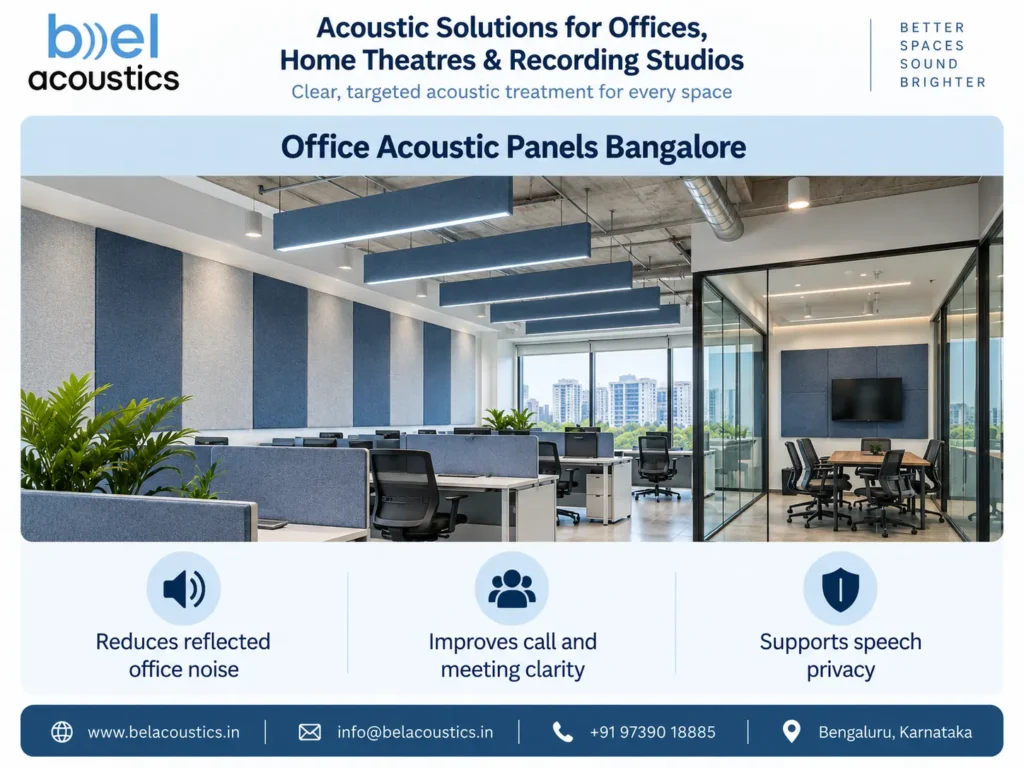
For most modern offices, a combination of PET acoustic treatment, fabric panels and ceiling absorption works well.
Typical problem areas include:
- Meeting rooms
- Conference rooms
- Open workstations
- Cafeterias
- Training rooms
- Reception areas
The WELL framework specifically addresses reverberation and sound-reducing surfaces as part of creating comfortable indoor environments.
For office projects, the goal is generally not complete silence.
The goal is to create an environment where conversations remain understandable without every discussion spreading across the entire floor.
Office Acoustic Panels Bangalore: Example Solution
Imagine an office with:
- Glass meeting-room walls
- Exposed concrete ceiling
- Tile flooring
- 60 employees
- Multiple video calls throughout the day
Employees may describe the space as noisy even when no individual sound source is extremely loud.
Why?
Hundreds of small sounds are reflecting through the room.
A possible acoustic strategy could combine:
- Suspended PET ceiling baffles
- Fabric wall panels
- Acoustic meeting-room treatment
- Strategic partitions
- Speech-privacy planning
The exact solution should still be determined by the space rather than copied from another office.
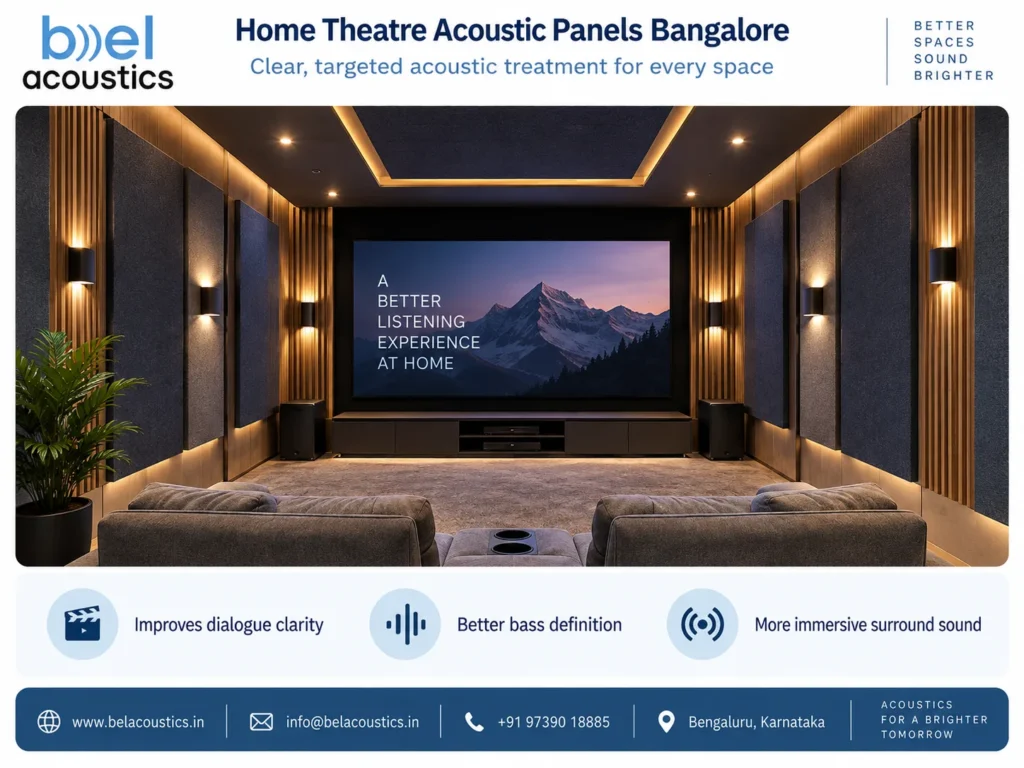
Home Theatre Acoustic Panels Bangalore
A home theatre requires greater acoustic control than a normal living room.
Treatment may include:
- Front-wall absorption
- Side-wall first-reflection treatment
- Rear-wall absorption or diffusion
- Bass absorption
- Ceiling treatment
The objective is not simply to create a silent room.
It is to allow the speaker system to perform with greater clarity and consistency.
A well-treated theatre can improve:
- Dialogue clarity
- Stereo imaging
- Surround localisation
- Bass definition
- Overall listening comfort
Recording Studio Acoustic Treatment Bangalore
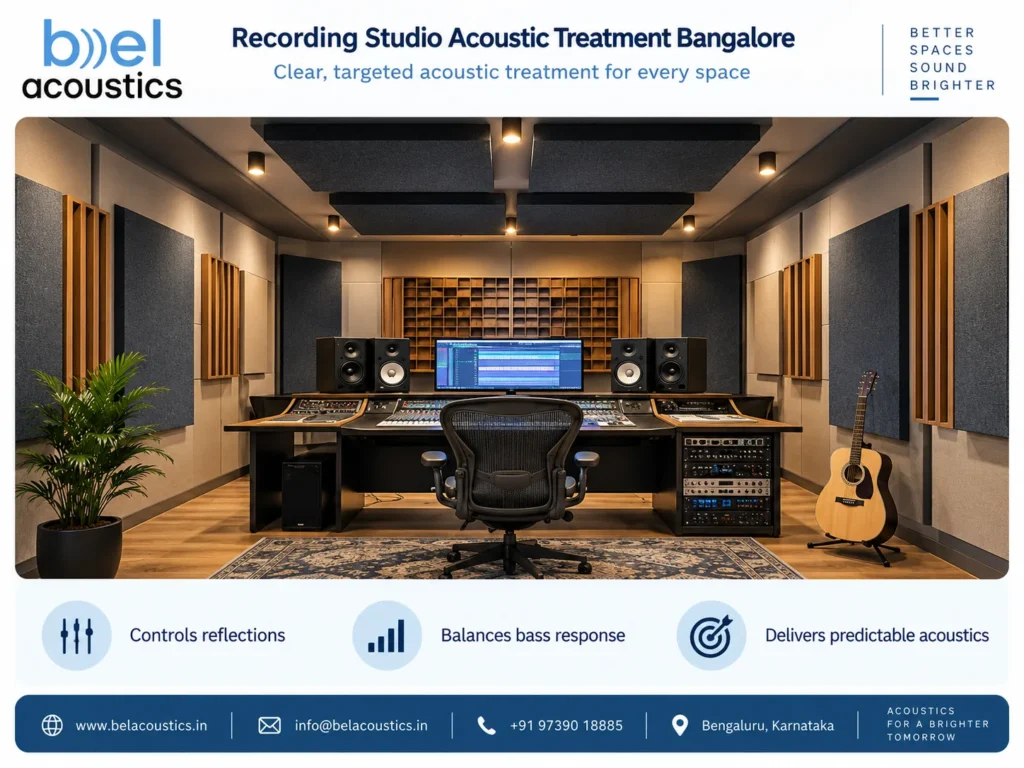
Recording and mixing rooms require careful acoustic design.
Typical treatment may combine:
- Broadband absorption
- Bass trapping
- Reflection control
- Ceiling clouds
- Diffusion
Recording studios should avoid both extremes:
Too reflective: recordings become coloured by room reflections.
Too absorptive: the room can become unnaturally dead.
The objective is controlled, predictable acoustics.
Common Mistakes When Buying Acoustic Panels
Mistake 1: Buying Panels Based Only on Appearance
A decorative panel is useful only when it provides the acoustic performance the room requires.
Mistake 2: Confusing Acoustic Panels With Soundproofing
Absorption controls reflections inside a room. It does not automatically stop sound passing through walls.
Mistake 3: Installing Panels Everywhere
More absorption is not always better.
Over-treatment can make a room dull and uncomfortable.
Mistake 4: Ignoring the Ceiling
In many offices, restaurants and commercial spaces, the ceiling is one of the largest untreated reflective surfaces.
Mistake 5: Ignoring Bass Problems
Home theatres and studios may require dedicated low-frequency treatment rather than simply additional thin panels.
Mistake 6: Choosing Panel Quantity Without Room Analysis
Twenty panels could be excessive for one room and inadequate for another.
Room volume, finishes and acoustic goals matter.
Mistake 7: Treating Symptoms Instead of Causes
If traffic noise is entering through a window, installing wall absorption is unlikely to solve the transmission problem.
First identify whether the issue is:
- Absorption
- Isolation
- Mechanical noise
- Impact noise
- Bass response
- Reverberation
Then choose the solution.
How Acoustic Panels Improve Interior Design
Acoustic products no longer need to look industrial.
Modern acoustic treatment can become part of the architecture itself.
Design options may include:
- Geometric PET walls
- Vertical acoustic fins
- Fabric feature walls
- Ceiling clouds
- Suspended baffles
- Wooden acoustic diffusers
- Custom colour combinations
For architects and interior designers, this creates an opportunity to solve sound problems while strengthening the visual identity of the space.
The best result happens when the acoustic consultant, architect and interior designer coordinate before construction is completed.
Apartment Soundproofing in Bangalore: Walls, Floors & Ceilings
Office Acoustic Solutions: Reduce Noise in Open Workspaces
Office Speech Privacy & Sound Masking Solutions in Bangalore
Home Theatre Acoustic Treatment Guide
How to Soundproof a Villa from Traffic & Neighbour Noise
Healthcare Acoustic Solutions for Hospitals & Clinics
Frequently Asked Questions
1. Which acoustic panels are best in Bangalore?
The best panel depends on the problem. Fabric and PET panels are effective for reverberation and speech control, bass absorbers address low-frequency problems, and diffusers help manage reflections in studios and critical listening rooms.
2. Do acoustic panels reduce outside traffic noise?
Not significantly on their own.
Acoustic panels mainly reduce reflections inside the room. External noise usually requires soundproofing or sound-insulation treatment involving walls, windows, doors, ceilings or other building elements.
3. Are PET acoustic panels good for offices?
Yes. PET acoustic panels are especially useful in offices because they can be manufactured as wall panels, ceiling baffles, hanging elements and decorative features while helping reduce unwanted reflections.
4. How many acoustic panels does my room need?
There is no fixed number.
Panel requirement depends on:
- Room dimensions
- Ceiling height
- Surface materials
- Room use
- Panel absorption performance
- Target acoustic condition
An acoustic assessment provides a more reliable answer than simply calculating panels by floor area.
5. Do home theatres need bass traps?
Many home theatres benefit from some form of low-frequency management.
Whether dedicated bass traps are required depends on room dimensions, speaker/subwoofer placement and acoustic measurements.
6. What is the difference between an acoustic absorber and a diffuser?
An absorber converts part of the sound energy into other forms of energy and reduces reflections.
A diffuser redistributes reflected sound across multiple directions.
Professional rooms may use both.
7. Can acoustic panels be customised for interior design?
Yes.
Fabric and PET acoustic panels can often be customised in different colours, sizes, shapes and layouts so the acoustic treatment complements the architectural design.
8. Where should acoustic panels be installed?
Depending on the room, acoustic treatment may be positioned on:
- Side walls
- Rear walls
- Ceilings
- First-reflection areas
- Corners
- Front walls
A site assessment helps determine the correct placement.
9. Who needs professional acoustic treatment in Bangalore?
Professional treatment can benefit:
- Offices
- Home theatres
- Recording studios
- Podcast studios
- Restaurants
- Cafés
- Schools
- Auditoriums
- Conference rooms
- Apartments
- Villas
- Commercial spaces
Choosing an Acoustic Panel Manufacturer in Bangalore
Do not choose an acoustic panel manufacturer Bangalore only based on panel price.
Look for a company that can understand:
- The acoustic problem
- The room dimensions
- The intended use
- The interior design
- Appropriate acoustic materials
- Product placement
- Installation requirements
The objective should be to solve the room’s acoustic problem—not simply sell the maximum number of panels.
Conclusion: Design the Room for Both Eyes and Ears
Beautiful interiors are not truly comfortable when every conversation echoes, music sounds uncontrolled or office noise makes concentration difficult.
The right acoustic panels Bangalore solution may include fabric acoustic panels, PET panels, low-frequency absorbers, acoustic diffusers—or a carefully designed combination of them.
The important part is identifying the acoustic problem before selecting the product.
For offices, home theatres, studios, commercial spaces and residential projects in Bengaluru, BEL Acoustics can help assess the space and design an acoustic treatment solution based on the room’s actual requirements.
Planning an acoustic project in Bangalore?
Contact BEL Acoustics for acoustic consultation, product selection, design and installation support.
Website: belacoustics.in
Email: info@belacoustics.in
Phone: +91 97390 18885
Location: Bengaluru, Karnataka