
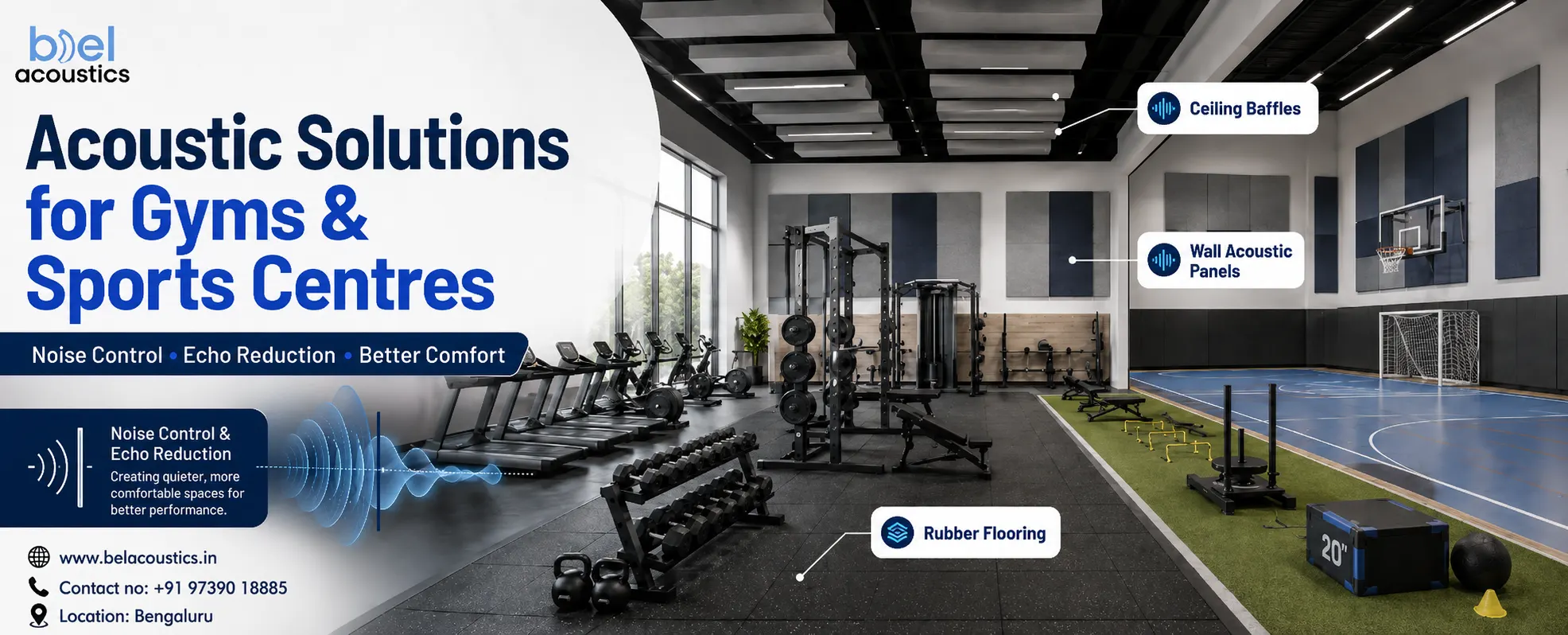

Gyms and sports centres are full of energy. But when music, machines, shouting, ball impact, and footsteps bounce around the room, the space can become too loud and uncomfortable.
That is why Acoustic Solutions for Gyms & Sports Centres are important. The right acoustic treatment helps reduce echo, control noise, improve speech clarity, and create a better experience for members, trainers, staff, and nearby occupants.
Whether it is a gym, fitness studio, indoor court, yoga room, CrossFit space, or sports training centre, good acoustic design makes the space feel more professional, comfortable, and safe.
Quick Answer: What Are the Best Acoustic Solutions for Gyms & Sports Centres?
The best acoustic solutions for gyms and sports centres include wall acoustic panels, ceiling acoustic baffles, acoustic ceiling clouds, rubber flooring, vibration isolation, bass control, and proper layout planning. These solutions reduce echo, control impact noise, improve speech clarity, and make fitness spaces more comfortable for users.
Why Gym Acoustics Matter
A gym is not like a normal room. It has many noise sources working at the same time.
Common sounds include:
- Loud music
- Treadmills and cardio machines
- Dropped weights
- Dumbbell impact
- Group class instructions
- Whistles and coaching voices
- Basketball, badminton, football, or indoor sports impact
- Footsteps and movement
- HVAC and ventilation noise
Without proper gym acoustics, these sounds reflect from hard surfaces and create echo. The result is a noisy, tiring, and unpleasant environment.
Good acoustic treatment helps:
- Reduce echo
- Improve trainer voice clarity
- Control workout noise
- Improve member comfort
- Protect nearby rooms from disturbance
- Create a premium fitness experience
- Support better communication during training
Common Noise Problems in Gyms & Sports Centres
1. Echo and Reverberation
Most gyms have hard surfaces such as concrete floors, glass walls, metal ceilings, mirrors, and gypsum partitions. These surfaces reflect sound.
When sound keeps bouncing, it creates reverberation.
This causes:
- Loud echo
- Poor speech clarity
- Harsh music sound
- Difficulty hearing trainers
- Noise fatigue for members and staff
Pro Tip: If people need to shout to talk inside the gym, the space needs acoustic treatment.
2. Impact Noise from Weights and Equipment
Weight training areas are one of the loudest parts of a gym. Dropped dumbbells, barbells, kettlebells, and machines create strong impact noise.
This noise can travel:
- Through floors
- Through walls
- Into neighbouring rooms
- To offices, apartments, or shops nearby
This is where gym soundproofing and vibration control become important.
3. Loud Music in Fitness Studios
Zumba studios, dance studios, spinning rooms, CrossFit areas, and HIIT zones often use high-volume music.
If the room is untreated, music becomes:
- Harsh
- Boomy
- Distorted
- Uncomfortable
- Disturbing to nearby areas
Proper fitness studio soundproofing helps control music leakage and improves sound quality inside the room.
4. Poor Speech Clarity
In sports centres and training spaces, coaches need to communicate clearly.
Poor acoustics can make it hard to hear:
- Instructions
- Safety warnings
- Class guidance
- Announcements
- Referee calls
Good sports centre acoustics improve speech clarity and reduce confusion during training.
5. Noise Complaints from Neighbours
Many gyms are located inside:
- Commercial buildings
- Mixed-use buildings
- Malls
- Apartment complexes
- Office spaces
- Basements
Without proper noise control, nearby tenants may complain about music, weights, vibration, and footsteps.
This can affect business reputation and daily operations.
Main Causes of Noise in Gyms and Sports Facilities
Hard Interior Surfaces
Gyms often use glass, concrete, tiles, metal, mirrors, and painted walls. These materials do not absorb sound well.
High Ceilings
Large sports halls and indoor courts usually have high ceilings. Sound travels far and creates long echo.
Open Layouts
Open gym layouts allow sound to spread freely from one zone to another.
Heavy Equipment
Treadmills, weight machines, plates, dumbbells, and racks create mechanical and impact noise.
Loud Group Classes
Group workouts combine music, movement, and trainer voice, making the room much louder.
Poor Acoustic Planning
Many gyms are designed for looks first. Acoustic comfort is often added only after complaints begin.
Acoustic Solutions for Gyms & Sports Centres
The right acoustic solution depends on the type of facility, room size, ceiling height, wall materials, equipment layout, and noise source.
Below are the most effective solutions.
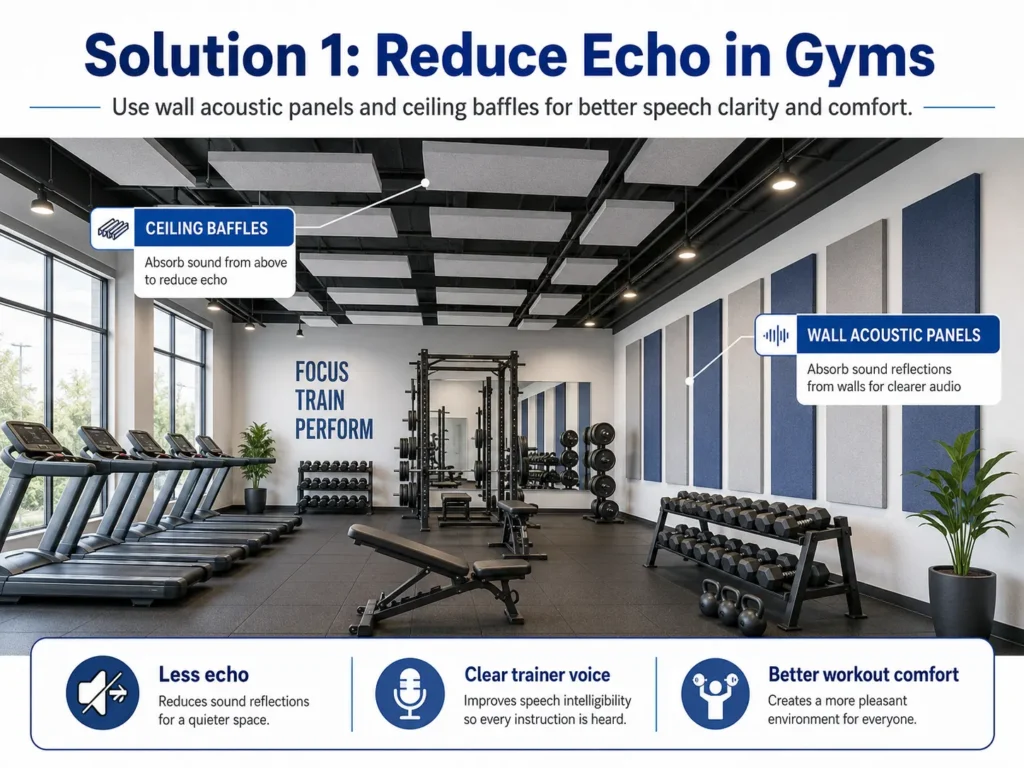
1. Acoustic Wall Panels for Gyms
Acoustic panels for gyms absorb sound reflections from walls. They reduce echo and make the room more comfortable.
Best areas to install wall acoustic panels:
- Weight training zones
- Cardio areas
- Group class rooms
- Reception areas
- Indoor sports halls
- Yoga and wellness studios
- Coaching rooms
- Waiting lounges
Benefits:
- Reduces echo
- Improves speech clarity
- Controls harsh sound
- Adds a premium interior look
- Helps balance music and voice
Pro Tip: In gyms, acoustic panels should be durable, easy to clean, and installed away from direct equipment impact zones.
2. Ceiling Acoustic Baffles for Gyms
Ceiling acoustic baffles for gyms are one of the best solutions for large spaces with high ceilings.
They hang vertically from the ceiling and absorb sound from multiple directions.
Best for:
- Indoor sports courts
- Gymnasiums
- CrossFit boxes
- Badminton courts
- Basketball courts
- Multipurpose sports halls
- Large fitness centres
Benefits:
- Controls reverberation
- Works well in high-ceiling rooms
- Does not take wall space
- Reduces overall noise build-up
- Improves comfort in large halls
3. Acoustic Ceiling Clouds
Ceiling clouds are horizontal acoustic panels installed above workout zones.
They are useful for:
- Reception areas
- Yoga studios
- Pilates studios
- Personal training rooms
- Premium fitness clubs
- Boutique gyms
Benefits:
- Reduces ceiling reflections
- Improves room comfort
- Looks clean and modern
- Works well with interior design
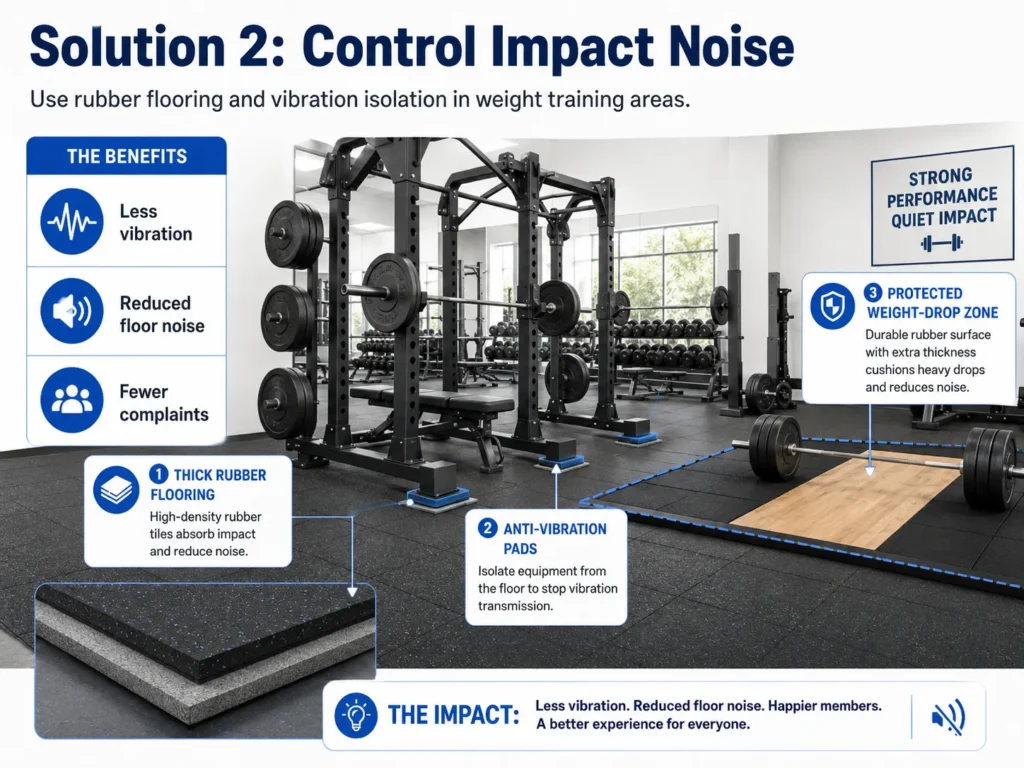
4. Rubber Flooring and Impact Isolation
For weight zones, flooring is very important. Basic tiles or thin mats cannot control impact noise properly.
Use:
- Heavy-duty rubber flooring
- Anti-vibration pads
- Floating floor systems
- Impact isolation layers
- Machine isolation mounts
Best for:
- Free weight areas
- Deadlift platforms
- CrossFit zones
- Treadmill areas
- Functional training spaces
Benefits:
- Reduces floor impact noise
- Controls vibration transfer
- Protects flooring
- Improves user safety
- Reduces complaints from lower floors
Pro Tip: For gyms above offices, shops, or homes, impact isolation should be planned before installation.
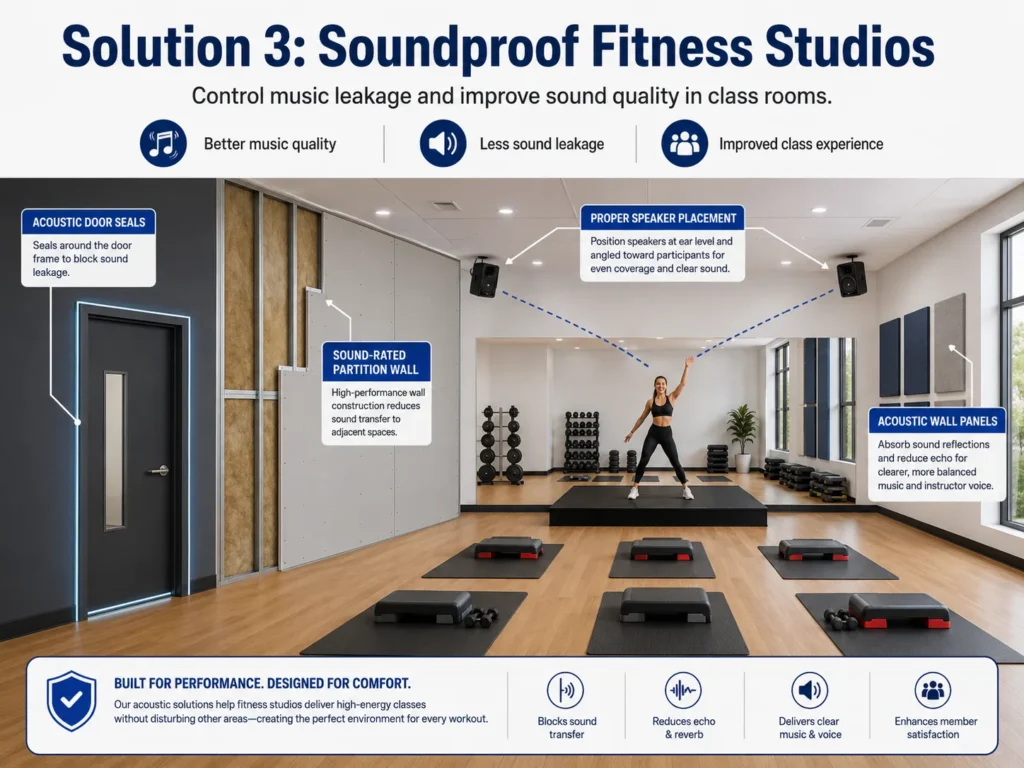
5. Soundproof Partitions for Fitness Studios
If a gym has separate rooms for dance, Zumba, spinning, or HIIT classes, normal partitions may not be enough.
Use sound-rated partitions with:
- Proper wall density
- Sealed joints
- Acoustic insulation
- Solid-core doors
- Door bottom seals
- Treated glass if required
Benefits:
- Reduces music leakage
- Controls voice transfer
- Improves privacy
- Allows multiple classes at the same time
6. Acoustic Doors and Door Sealing
A lot of sound escapes through door gaps.
For better fitness centre acoustic solutions, use:
- Solid-core acoustic doors
- Drop-down door seals
- Perimeter seals
- Proper frame sealing
- Double-door entry where needed
This is useful for:
- Studio rooms
- Music-based workout rooms
- Sports training rooms
- Staff rooms
- Consultation rooms
7. Bass and Music Control
Loud music in fitness studios can create low-frequency sound problems. Bass travels through walls and floors more easily than normal speech.
Solutions include:
- Bass traps
- Wall build-up improvement
- Speaker placement planning
- Vibration isolation for speakers
- Volume zoning
- Acoustic absorption behind speakers
Pro Tip: Do not solve loud music problems only by adding foam. Low-frequency sound needs proper acoustic design.
8. Zone-Based Acoustic Planning
A gym should not be treated as one single room. Each zone has a different noise profile.
Plan acoustics based on zones:
- Reception Area
Needs speech clarity and a calm first impression. - Cardio Zone
Needs machine noise control and ceiling/wall absorption. - Weight Training Zone
Needs impact noise control and vibration isolation. - Group Class Studio
Needs soundproofing, music control, and speech clarity. - Yoga or Pilates Room
Needs calm, soft acoustics and outside noise reduction. - Indoor Sports Court
Needs reverberation control and durable acoustic materials. - Changing Rooms
Need privacy and echo control.
Real-World Examples
Example 1: Gym in a Commercial Building
Problem: The gym is above an office. Staff below can hear dumbbells and treadmill vibration.
Solution:
- Install rubber flooring
- Add vibration isolation below machines
- Create dedicated weight drop zones
- Use wall and ceiling absorption
- Seal service openings
Result: Lower impact noise and fewer complaints.
Example 2: Zumba Studio with Loud Music
Problem: Music from the studio disturbs the reception and nearby shops.
Solution:
- Add acoustic wall panels
- Install sound-rated partitions
- Seal doors
- Treat ceiling reflections
- Adjust speaker placement
Result: Better music quality inside and reduced leakage outside.
Example 3: Indoor Badminton Court
Problem: Shuttle sound, footsteps, coaching voices, and crowd noise create heavy echo.
Solution:
- Add ceiling acoustic baffles
- Treat upper wall areas
- Use durable acoustic panels
- Control reverberation time
Result: Better speech clarity and a more comfortable playing environment.
Step-by-Step Acoustic Treatment Strategy
1. Identify the Noise Source
First, understand where the noise is coming from.
Check:
- Music
- Weights
- Machines
- Footsteps
- Sports impact
- Trainer voice
- HVAC noise
- Outside traffic noise
2. Measure the Room Conditions
A professional acoustic consultant will check:
- Room size
- Ceiling height
- Wall materials
- Floor type
- Noise levels
- Echo level
- Adjacent rooms
- Equipment placement
This helps create the right acoustic plan.
3. Separate Soundproofing and Sound Absorption
Many people confuse these two.
Sound Absorption
This controls echo inside the room.
Examples:
- Acoustic panels
- Ceiling baffles
- Ceiling clouds
- Fabric-wrapped panels
Soundproofing
This blocks sound from entering or leaving the room.
Examples:
- Acoustic doors
- Wall insulation
- Sealed partitions
- Floating floors
- Vibration isolation
A gym may need both.
4. Treat the Ceiling First in Large Spaces
In large gyms and indoor sports centres, the ceiling is usually the biggest untreated surface.
Ceiling treatment can make a major difference in:
- Echo reduction
- Speech clarity
- Overall noise control
- Comfort during peak hours
5. Add Wall Panels in Reflection Zones
Wall panels should be placed where sound reflections are strongest.
Best locations:
- Opposite mirrors
- Behind speakers
- Side walls of group studios
- Upper wall sections in sports halls
- Around cardio zones
- Near reception and waiting areas
6. Control Impact Noise at the Floor
For weight training areas, floor treatment is essential.
Use:
- Thick rubber tiles
- Shock pads
- Deadlift platforms
- Isolated machine bases
- Floating floor systems for upper floors
7. Seal Gaps and Openings
Sound leaks through small gaps.
Seal:
- Door gaps
- Window gaps
- Wall joints
- AC openings
- Cable openings
- False ceiling gaps
Even a small opening can reduce the performance of a soundproof room.
8. Choose Durable Acoustic Materials
Gyms need strong materials. Avoid weak or low-quality products that tear, sag, or collect dust.
Choose materials that are:
- Durable
- Safe
- Fire-rated where required
- Easy to maintain
- Suitable for commercial use
- Visually matching the interior
Common Mistakes in Gym Soundproofing
1. Using Only Foam Panels
Foam may reduce a small amount of echo, but it does not solve serious gym noise or vibration problems.
2. Ignoring the Ceiling
Many gyms treat only the walls. But in large spaces, the ceiling often causes the biggest echo problem.
3. Treating the Room After Complaints
Acoustics should be planned during design, not after customers or neighbours complain.
4. Using Thin Flooring in Weight Zones
Thin mats are not enough for heavy dumbbells, deadlifts, and machines.
5. Not Sealing Doors
Even expensive soundproof walls can fail if the door has gaps.
6. Poor Speaker Placement
Speakers facing glass, mirrors, or hard walls can make music sound harsh and loud.
7. Copying Another Gym’s Acoustic Design
Every gym is different. Room size, ceiling height, equipment, and noise levels must be studied before choosing a solution.
Best Acoustic Materials for Gyms and Sports Centres
Common materials include:
- Fabric acoustic panels
- PET acoustic panels
- Wooden grooved acoustic panels
- Ceiling acoustic baffles
- Acoustic ceiling clouds
- Rubber flooring
- Anti-vibration pads
- Acoustic insulation
- Acoustic doors
- Bass traps
- Sound-rated partitions
The best choice depends on the room type and noise problem.
Benefits of Professional Gym Acoustic Design
Professional sports facility acoustic design improves both comfort and business value.
Benefits include:
- Better member experience
- Clear trainer communication
- Reduced echo
- Lower noise complaints
- Better music quality
- More premium brand image
- Safer workout environment
- Better zoning between activities
- Improved staff comfort
- Higher customer satisfaction
Acoustic Solutions in Bengaluru for Gyms & Sports Centres
Gyms in Bengaluru often operate inside commercial buildings, mixed-use spaces, tech parks, malls, and residential neighbourhoods. This makes noise control very important.
BEL Acoustics provides acoustic solutions in Bengaluru for:
- Gyms
- Fitness studios
- CrossFit centres
- Yoga studios
- Pilates studios
- Dance studios
- Indoor sports halls
- Badminton courts
- Basketball courts
- Sports academies
- Wellness centres
- Commercial fitness chains
Our solutions are designed for Indian building conditions, local noise challenges, and commercial usage.
- Office Acoustic Solutions for Open Workspaces
- Auditorium Acoustic Design
- Acoustic Solutions for Shopping Malls
- Home Theater Acoustic Design
- Soundproofing Solutions for Villas
- Acoustic Panels for Commercial Interiors
- Ceiling Acoustic Treatment Solutions
- Podcast Studio Acoustic Solutions
- Healthcare Acoustic Solutions
FAQs About Acoustic Solutions for Gyms & Sports Centres
1. Why do gyms have so much echo?
Gyms have echo because they use hard surfaces like concrete, glass, mirrors, tiles, and metal ceilings. These surfaces reflect sound instead of absorbing it. Acoustic panels, ceiling baffles, and ceiling clouds help reduce echo.
2. What is the best acoustic treatment for gyms?
The best acoustic treatment for gyms includes wall acoustic panels, ceiling acoustic baffles, rubber flooring, vibration isolation, acoustic doors, and proper speaker placement. The right solution depends on the room size and noise source.
3. Do acoustic panels reduce gym noise
Yes, acoustic panels reduce echo and sound reflections inside a gym. They make the space more comfortable and improve speech clarity. However, they do not fully block sound from going outside. For that, soundproofing is needed.
4. How can I reduce noise from gym weights?
To reduce weight noise, use thick rubber flooring, impact isolation mats, deadlift platforms, anti-vibration pads, and proper weight zone planning. For upper floors, floating floor systems may be needed.
5. What are ceiling acoustic baffles for gyms?
Ceiling acoustic baffles are sound-absorbing panels suspended from the ceiling. They are useful in high-ceiling gyms, indoor courts, sports halls, and large fitness centres because they reduce echo and reverberation.
6. Is gym soundproofing different from acoustic treatment?
Yes. Acoustic treatment controls echo inside the gym. Soundproofing blocks sound from entering or leaving the gym. Most gyms need a mix of both, especially if they are located near offices, homes, or other businesses.
7. Can acoustic solutions improve fitness studio music quality?
Yes. Proper acoustic treatment reduces harsh reflections and controls boominess. This makes music sound clearer and more balanced in Zumba, spinning, dance, and HIIT studios.
8. Are acoustic panels suitable for indoor sports facilities?
Yes. Acoustic panels and ceiling baffles are suitable for indoor sports facilities when the right durable materials are used. They help reduce echo, improve speech clarity, and create a better playing environment.
Conclusion
A noisy gym can affect member comfort, trainer communication, staff productivity, and nearby occupants. The right Acoustic Solutions for Gyms & Sports Centres help reduce echo, control impact noise, improve music quality, and create a premium fitness experience.
From wall acoustic panels and ceiling baffles to rubber flooring, soundproof partitions, and vibration isolation, every solution should be planned based on the space, activity, and noise source.
If you are planning a gym, fitness studio, indoor court, or sports centre in Bengaluru, BEL Acoustics can help you design the right acoustic solution from the start.
Need expert help with gym acoustics or sports centre noise control?
Contact BEL Acoustics for professional acoustic consultation, design, and installation.
Website: www.belacoustics.in
Phone: +91 97390 18885
Location: Bengaluru, Karnataka 560099