
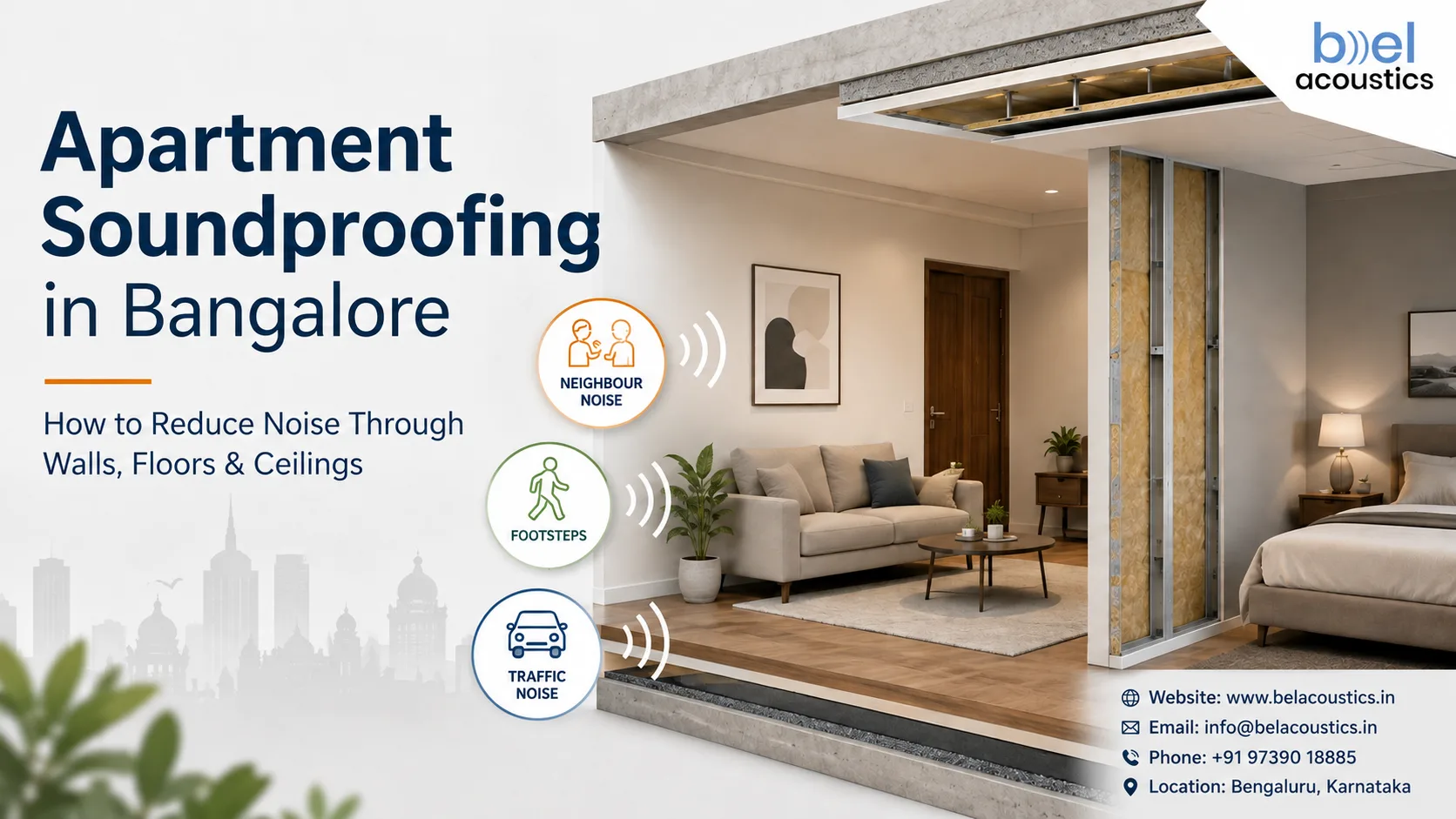

Reduce neighbour, floor and ceiling noise with professional apartment soundproofing in Bangalore. Explore effective solutions for quieter, more comfortable flats.
Living in an apartment should feel peaceful. But traffic, upstairs footsteps, furniture movement, loud conversations, television sound and neighbouring apartments can quickly disturb that comfort.
Professional apartment soundproofing in Bangalore focuses on identifying how noise enters your flat and treating the walls, floors, ceilings, doors and other weak points accordingly.
The important part is choosing the right solution. Acoustic panels alone cannot solve every noise problem. Effective soundproofing depends on understanding the type of noise, its transmission path and the construction of the apartment.
This guide explains how apartment soundproofing works and how you can reduce noise through walls, floors and ceilings.
Quick Answer: How Can You Soundproof an Apartment?
Apartment soundproofing reduces noise by adding mass, isolation, absorption and airtightness to walls, ceilings and floors. For neighbour conversations, wall soundproofing systems are commonly used. For footsteps and furniture movement, floor or ceiling isolation may be required. The correct treatment depends on whether the noise is airborne, impact-based or structure-borne.
Why Is Apartment Noise Such a Common Problem?
Apartment buildings share walls, floors, ceilings and structural elements.
Because of this, sound can travel from one home to another through several different paths.
Common apartment noise problems include:
- Conversations from neighbouring flats
- Television and music
- Children playing
- Footsteps from the apartment above
- Furniture dragging
- Door slamming
- Kitchen appliance vibration
- Plumbing noise
- Lift and mechanical equipment noise
- Traffic and vehicle horns
- Construction activity
- Dogs barking
- Home theatre or subwoofer bass
Before selecting any soundproofing solutions for flats, it is important to identify exactly where the noise originates.
Understanding the Three Main Types of Apartment Noise
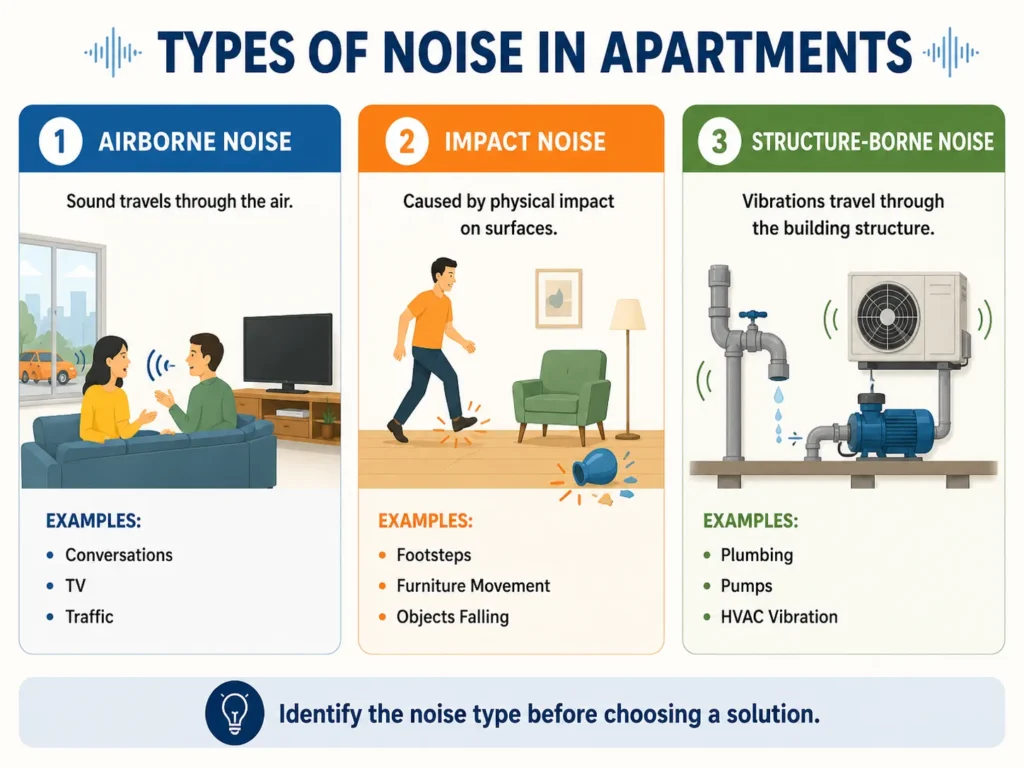
1. Airborne Noise
Airborne noise travels through the air before passing through walls, doors, ceilings or other building elements.
Examples include:
- Conversations
- Television
- Music
- Traffic
- Dogs barking
- Children shouting
Airborne noise usually requires improvements to the sound isolation performance of the separating surface.
2. Impact Noise
Impact noise happens when something physically hits the building structure.
Examples include:
- Footsteps
- Chairs moving
- Furniture dragging
- Objects falling
- Children running
- Gym equipment
Impact vibration can travel through the floor slab and appear as noise in the apartment below.
This is why floor noise reduction often requires a different approach from wall soundproofing.
3. Structure-Borne Noise
Structure-borne sound travels through concrete slabs, columns, beams, walls and other building elements.
Examples include:
- Pumps
- HVAC systems
- Elevators
- Plumbing
- Heavy machinery
- Subwoofer vibration
- Generator vibration
Structure-borne noise can be difficult to diagnose because the noise may appear far away from its actual source.
Pro Tip: Never choose a soundproofing material simply because the noise appears to come from one wall. The real transmission path may be the ceiling, floor, service shaft or adjoining structure.
Apartment Soundproofing in Bangalore: Start With a Noise Assessment
Before installing acoustic materials, identify four things:
- What type of noise are you hearing?
- Where is the noise coming from?
- How is the noise entering the room?
- How much noise reduction do you actually need?
A professional soundproofing contractor in Bangalore may inspect:
- Shared walls
- Ceiling construction
- Floor structure
- Doors
- Windows
- Electrical sockets
- Plumbing penetrations
- HVAC openings
- Gaps around frames
- Service shafts
- False ceilings
This assessment helps avoid spending money on treatments that do not address the real problem.
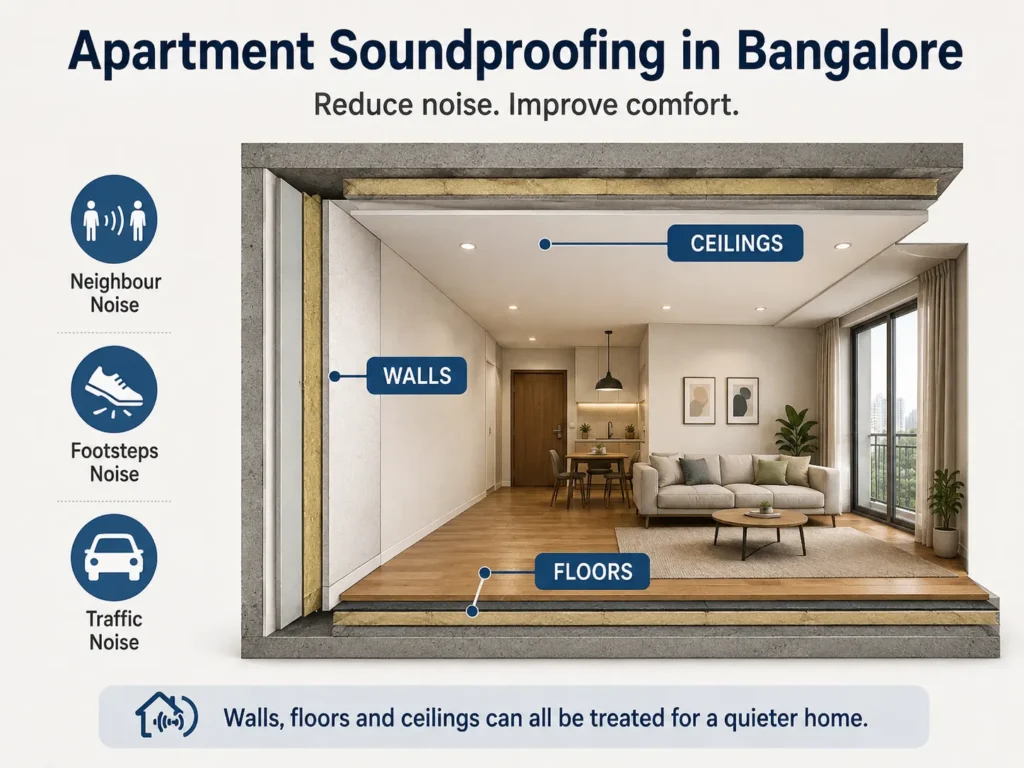
How to Soundproof Apartment Walls
Noise through shared walls is one of the most common complaints in apartment buildings.
If you hear conversations, television or music from the flat next door, the partition may not provide enough sound isolation.
Wall Soundproofing for Apartments
An effective wall soundproofing system usually uses more than one principle.
These may include:
Adding Mass
Heavier wall systems generally resist airborne sound transmission better than very lightweight partitions.
Additional layers may be introduced using suitable building boards or specialised acoustic materials.
Creating Separation
Instead of allowing two wall surfaces to remain rigidly connected, isolation techniques can reduce vibration transfer.
A properly designed independent or isolated lining can significantly improve performance.
Adding Absorptive Material Inside the Cavity
Suitable acoustic insulation inside the wall cavity can reduce resonances and improve the overall performance of the system.
Sealing Air Gaps
Even small gaps can reduce the performance of a soundproof wall.
Special attention should be given to:
- Wall edges
- Electrical sockets
- Pipe penetrations
- Door frames
- Junctions between walls and ceilings
Pro Tip: Think of soundproofing like waterproofing. A high-performance wall can still underperform if noise can easily pass through gaps around it.
Soundproofing Apartment Walls Without Major Demolition
In occupied apartments, owners often want to reduce noise without rebuilding the complete wall.
Depending on the situation, an additional sound-isolated wall lining may be installed over the existing wall.
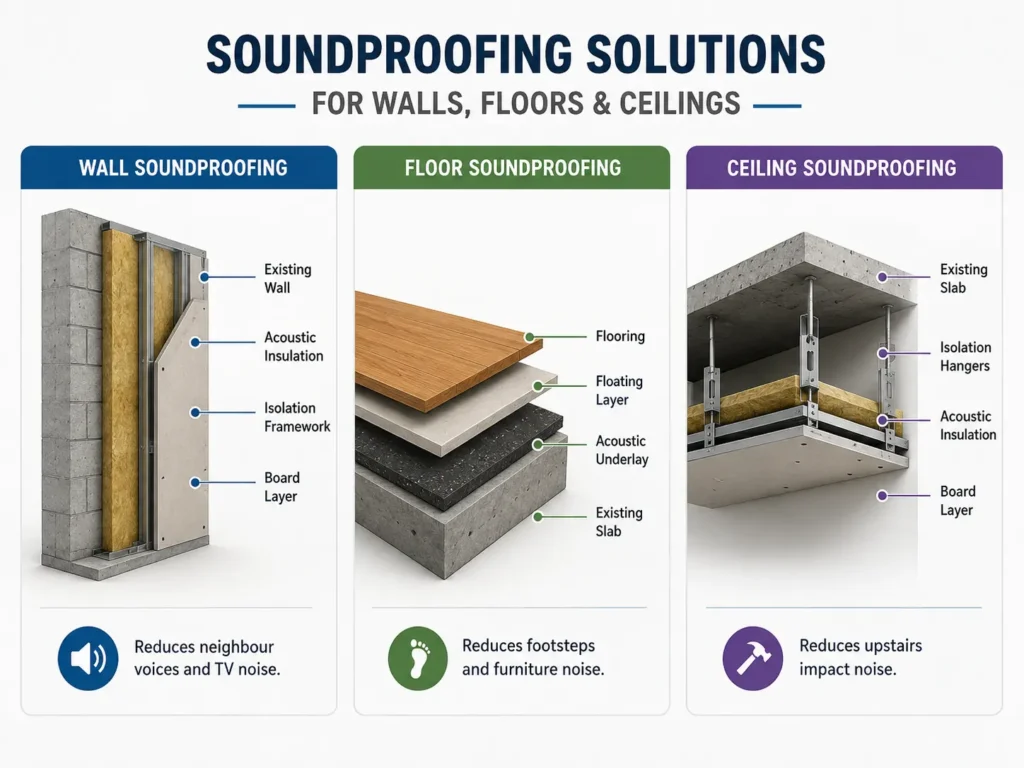
A typical system may include:
- Isolation framework
- Acoustic insulation
- Multiple layers of dense boards
- Acoustic sealant
- Proper perimeter sealing
The exact construction should be selected based on the available space and target noise reduction.
One disadvantage is that the system will reduce the room dimensions slightly.
However, for severe neighbour noise, this can provide a much better result than simply installing decorative acoustic panels.
Floor Soundproofing Bangalore: How to Reduce Impact Noise
Floor soundproofing is especially useful when footsteps, furniture movement or impact noise is transferring to the apartment below.
The best stage to address this problem is usually during flooring installation or renovation.
Common Floor Noise Reduction Methods
Acoustic Underlay
Resilient underlays may be installed below flooring such as:
- Wooden flooring
- Laminate
- Engineered wood
- Certain tile systems
The underlay helps separate the finished floor from the main structure.
Floating Floor Systems
A floating floor is designed so the finished floor is mechanically separated from the structural slab using resilient materials.
This can provide significantly better impact isolation when designed correctly.
Carpet and Soft Flooring
Carpets and rugs can reduce direct impact noise from footsteps.
However, they generally provide much less isolation than a properly engineered floating floor.
Vibration Isolation
If equipment such as gym machines, speakers or washing machines causes vibration, appropriate isolation pads or mounts may be required.
Pro Tip: If the noise problem affects your neighbour below, treating your floor is generally more effective than asking them to treat their ceiling.
Ceiling Soundproofing Bangalore: Reducing Noise From Upstairs
Footsteps from upstairs apartments are one of the most frustrating residential noise problems.
People often assume that adding a false ceiling will solve the issue.
Unfortunately, a normal gypsum false ceiling alone may provide only limited improvement.
Effective Ceiling Noise Reduction
A sound-isolated ceiling system can include:
- Resilient suspension systems
- Acoustic insulation
- Suitable air cavity
- Multiple dense board layers
- Acoustic sealing around edges
- Isolation from the structural slab where possible
The goal is to reduce the direct vibration path between the slab and the new ceiling.
Can a False Ceiling Reduce Footstep Noise?
A standard false ceiling may reduce some airborne noise, but impact noise requires additional isolation.
For strong footstep noise, treatment at the upstairs floor is generally more effective because the vibration is controlled closer to its source.
When access to the apartment above is impossible, an isolated ceiling system may still improve conditions inside your flat.Can a False Ceiling Reduce Footstep Noise?
A standard false ceiling may reduce some airborne noise, but impact noise requires additional isolation.
For strong footstep noise, treatment at the upstairs floor is generally more effective because the vibration is controlled closer to its source.
When access to the apartment above is impossible, an isolated ceiling system may still improve conditions inside your flat.
How to Reduce Neighbour Noise in an Apartment
If neighbour noise is affecting your sleep, work or daily comfort, follow this process.
1. Identify the Noise Source
Determine whether the main issue is:
- Voices
- TV
- Music
- Footsteps
- Furniture
- Doors
- Plumbing
- Equipment vibration
Different noise sources require different solutions.
2. Find the Transmission Path
Listen near:
- Shared walls
- Ceiling edges
- Electrical outlets
- Doors
- Windows
- Service shafts
The loudest surface is not always the true transmission path, but this initial check can provide useful clues.
3. Check Doors and Windows
Noise may bypass your walls through poorly sealed openings.
Check:
- Door gaps
- Window seals
- Sliding doors
- Balcony doors
- Ventilation openings
A small untreated opening can reduce the overall performance of an otherwise strong soundproofing system.
4. Treat the Weakest Building Element
If the shared wall is the weakest point, upgrade the wall.
If the noise comes from upstairs footsteps, consider floor or ceiling isolation.
If outside traffic is the main problem, windows may require greater attention.
5. Seal Penetrations
Seal unnecessary gaps around:
- Electrical conduits
- Pipes
- AC penetrations
- Frames
- Wall-to-ceiling junctions
6. Test the Result
After treatment, listen during the same conditions that originally created the problem.
For larger projects, acoustic measurements can provide more objective performance verification.
Soundproofing vs Acoustic Treatment: Know the Difference
This is one of the biggest areas of confusion in residential acoustics.
Soundproofing
Soundproofing aims to stop sound from travelling from one space to another.
It commonly involves:
- Mass
- Isolation
- Airtightness
- Decoupling
- Vibration control
Acoustic Treatment
Acoustic treatment improves the sound quality inside a room.
It may involve:
- Acoustic wall panels
- Ceiling panels
- Bass treatment
- Fabric acoustic systems
- Diffusers
These treatments reduce:
- Echo
- Reverberation
- Harsh reflections
But standard acoustic panels are not designed primarily to block neighbour noise.
Simple Example
If your living room sounds echoey when you speak, acoustic panels may help.
If you can clearly hear your neighbour speaking through the wall, you probably need sound isolation, not just acoustic panels.
Which Areas of an Apartment Can Be Soundproofed?
Professional residential soundproofing in Bangalore can be designed for many parts of a home.
Bedrooms
Reduce:
- Neighbour conversations
- Traffic noise
- TV noise
- Corridor noise
Home Offices
Improve privacy and reduce distractions caused by surrounding activity.
Living Rooms
Control:
- Neighbour noise
- Entertainment system sound
- External traffic
Home Theatres
Prevent loud movie playback and bass from disturbing other rooms or neighbouring apartments.
Children’s Rooms
Reduce noise transfer between children’s bedrooms and adjacent spaces.
Music Rooms
Provide greater isolation for:
- Instruments
- Vocals
- Recording
- Practice rooms
Apartments Near Main Roads
Window, façade and opening treatments may help reduce external traffic noise.
Acoustic Solutions for Apartments
Not every apartment requires complete construction-level soundproofing.
Different problems may require different combinations of treatments.
Possible acoustic solutions for apartments include:
- Sound-isolated wall linings
- Acoustic doors
- Door seals
- Secondary window systems
- Acoustic laminated glazing
- Floor isolation
- Floating floors
- Resilient ceiling systems
- Acoustic insulation
- Pipe and service penetration treatment
- Equipment vibration isolation
- Acoustic wall panels
- Ceiling absorbers
The correct combination depends on the problem.
Apartment Noise Reduction: A Step-by-Step Strategy
For homeowners planning an apartment noise-control project, this sequence is practical.
Step 1: Document the Noise
Write down:
- When the noise occurs
- How long it lasts
- Which room is affected
- Where it sounds strongest
- Whether it is voice, impact or vibration
Step 2: Inspect the Room
Look for obvious weak points including:
- Gaps
- Thin doors
- Windows
- Shared partitions
- Ceiling openings
- Electrical outlets
Step 3: Diagnose the Noise Type
Separate the problem into:
- Airborne
- Impact
- Structure-borne
Step 4: Set Your Expectations
Complete silence is rarely practical in an apartment.
The objective should be a meaningful reduction that makes the space more comfortable.
Step 5: Design the Treatment
Choose an appropriate wall, ceiling or floor build-up according to:
- Available space
- Existing construction
- Noise level
- Interior requirements
- Budget
Step 6: Execute Carefully
Soundproofing performance depends heavily on workmanship.
Small construction errors can create sound bridges that reduce the effectiveness of the whole system.
Step 7: Review After Installation
Check whether the original noise problem has improved and whether additional transmission paths remain.
Common Apartment Soundproofing Mistakes
Mistake 1: Using Acoustic Foam to Block Noise
Acoustic foam mainly absorbs reflections inside a room.
It is not a complete solution for blocking neighbour noise.
Mistake 2: Installing Decorative Panels on a Shared Wall
Decorative acoustic panels may improve room acoustics, but they normally do not provide enough mass and isolation to substantially block sound passing through the building.
Mistake 3: Ignoring Doors and Windows
Even after wall treatment, noise can enter through:
- Door gaps
- Windows
- Ventilation openings
Always consider the complete room.
Mistake 4: Treating Only the Surface Where Noise Is Heard
Sound can travel around the treated surface through:
- Ceilings
- Floors
- Adjacent walls
- Structural columns
This phenomenon is called flanking transmission.
Mistake 5: Using a Standard False Ceiling for Heavy Footstep Noise
Impact noise travels through the structure.
A properly isolated ceiling system is usually required for meaningful improvement.
Mistake 6: Choosing Materials Without Designing a System
Soundproofing does not depend on one “magic” material.
Performance comes from the complete system, including:
- Material density
- Layer arrangement
- Isolation
- Cavity depth
- Sealing
- Installation quality
Mistake 7: Ignoring Low-Frequency Noise
Bass from subwoofers and home theatres is much harder to control than normal speech.
Low-frequency noise often requires more substantial isolation and structural consideration.

How Much Space Does Apartment Soundproofing Require?
This depends on the system.
A thin treatment may require relatively little space but provide limited improvement.
High-performance wall or ceiling systems usually require additional depth because they need:
- Isolation
- Air cavity
- Absorptive insulation
- Multiple finishing layers
The best approach is therefore to balance sound reduction requirements against available room dimensions.
When Should You Hire a Soundproofing Contractor in Bangalore?
Professional assistance is recommended when:
- Neighbour noise is clearly audible
- Footsteps from upstairs are disturbing sleep
- Home theatre sound affects adjoining flats
- Traffic noise remains high with windows closed
- You are renovating your apartment
- Multiple rooms require treatment
- Previous soundproofing attempts failed
- Low-frequency vibration is involved
An experienced soundproofing contractor in Bangalore should first understand the problem before recommending materials.
Avoid solutions based only on selling a particular acoustic product.
Apartment Soundproofing During Renovation vs After Move-In
During Renovation
This is usually the ideal time.
Soundproofing can be integrated into:
- Wall construction
- Flooring
- False ceilings
- Doors
- Windows
- HVAC openings
This provides greater flexibility and often a cleaner final finish.
After Moving In
Soundproofing can still be carried out in occupied flats.
However, solutions may need to work around:
- Existing furniture
- Finished flooring
- Electrical systems
- Interior cabinetry
- Limited wall thickness
A site-specific design becomes even more important.
Real-World Example: Noisy Shared Bedroom Wall
Imagine a bedroom sharing a wall with the neighbour’s living room.
Every night, conversations and television sound are audible.
Simply installing fabric acoustic panels may make your own bedroom less echoey but will probably not solve the transmission problem.
A better approach would be to:
- Inspect the shared wall.
- Check electrical sockets and gaps.
- Identify flanking transmission.
- Build an isolated wall lining if required.
- Add suitable acoustic insulation.
- Add dense finishing layers.
- Seal the complete perimeter.
This approach tackles the noise transmission path, rather than simply covering the wall.
Real-World Example: Footsteps From the Apartment Above
Suppose you regularly hear:
- Footsteps
- Chairs moving
- Objects dropping
This is mainly impact noise.
Ideally, the upstairs floor should be treated with a suitable resilient layer or floating flooring system.
If upstairs access is unavailable, a properly isolated acoustic ceiling may help reduce the noise inside your apartment.
This illustrates why accurate diagnosis is essential.
Benefits of Professional Apartment Soundproofing
A properly designed apartment noise-control solution can help create:
- Better sleep
- Greater privacy
- Reduced distractions
- More comfortable work-from-home spaces
- Improved home theatre isolation
- Reduced disturbance between family rooms
- Better overall living comfort
For premium homes and apartments, good acoustic planning can also become an important part of the overall interior design.
FAQs About Apartment Soundproofing in Bangalore
1. Can I completely soundproof my apartment?
Complete sound isolation is difficult because an apartment shares structural elements with surrounding flats. However, properly designed wall, ceiling, floor, door and window treatments can significantly reduce unwanted noise.
2. What is the best way to reduce neighbour noise through a wall?
For significant neighbour noise, an isolated wall lining with acoustic insulation, dense board layers and proper perimeter sealing is generally more effective than standard acoustic panels.
3. Do acoustic panels stop sound from neighbours?
Acoustic panels primarily reduce echo and reverberation within the room. They are not normally sufficient for blocking significant noise passing through an apartment wall.
4. How can I reduce footsteps from the apartment above?
The most effective solution is usually treating the upstairs floor using resilient flooring or a floating floor system. When this is not possible, an isolated acoustic ceiling can help reduce the transmitted noise.
5. Can a false ceiling reduce upstairs noise?
A normal false ceiling may provide limited improvement. A sound-isolated ceiling using resilient suspension, acoustic insulation, dense layers and proper sealing is generally more effective.
6. Can apartment floors be soundproofed?
Yes. Floor soundproofing in Bangalore projects may use acoustic underlays, resilient layers, floating floors or vibration-isolation solutions depending on the type of impact noise.
7. Can I soundproof an apartment without damaging the existing wall?
In many cases, an independent acoustic lining can be constructed in front of the existing wall. The appropriate method depends on available space, wall construction and the required level of noise reduction.
8. Can soundproofing help with Bangalore traffic noise?
Yes, but external traffic noise frequently enters through windows, balcony doors and façade openings. Improving the wall without addressing these weak areas may provide limited results.
9. Is apartment acoustic treatment the same as apartment soundproofing?
No. Acoustic treatment controls echo inside the room. Soundproofing reduces sound transmission between different spaces.
10. Should soundproofing be done before interior work?
Whenever possible, yes. Integrating soundproofing during renovation makes it easier to coordinate walls, flooring, ceilings, electrical systems and interior finishes.
- Home Soundproofing Solutions in Bangalore
- How to Soundproof a Villa From Traffic, Neighbours & Construction Noise
- Home Theatre Acoustic Solutions
- Acoustic Panels for Homes
- Noise Control Solutions in Bangalore
- Residential Acoustic Consultation
- Soundproof Windows and Doors
- Home Theatre Sound Isolation Guide
Conclusion: Create a Quieter Apartment With the Right Acoustic Solution
Apartment noise is rarely solved by simply adding one layer of foam or a few decorative panels.
Effective apartment soundproofing in Bangalore starts by understanding whether the problem is coming through the walls, floors, ceilings, doors, windows or building structure.
Once the transmission path is identified, the right combination of mass, isolation, absorption, sealing and vibration control can provide a meaningful improvement.
Whether you are dealing with neighbour conversations, upstairs footsteps, traffic noise or home theatre sound, BEL Acoustics can design a solution around your apartment’s actual construction and noise problem.
BEL Acoustics provides customised soundproofing and acoustic solutions for apartments, flats, villas and residential spaces across Bangalore.
Get your space assessed before investing in unnecessary materials.
Contact BEL Acoustics
Website: www.belacoustics.in
Email: info@belacoustics.in
Phone: +91 97390 18885
Location: Bengaluru, Karnataka
Reduce the noise. Improve your privacy. Enjoy your home again.