

Hospitals and clinics are meant to heal people. But when noise, echo, and lack of speech privacy disturb the space, patients feel stressed and doctors struggle to communicate clearly.
Healthcare Acoustic Solutions for Hospitals, Clinics & Consultation Rooms help reduce unwanted noise, improve patient comfort, protect private conversations, and create a better medical experience for everyone.
From reception areas to doctor cabins, consultation rooms, ICUs, diagnostic rooms, and waiting areas, good acoustic design is no longer optional. It is an important part of modern healthcare interiors.
Quick Answer: What Are Healthcare Acoustic Solutions?
Healthcare acoustic solutions are sound control systems used in hospitals, clinics, and consultation rooms to reduce noise, echo, and speech leakage. They include acoustic panels, soundproof partitions, ceiling treatments, door sealing, wall insulation, and layout planning to improve patient privacy, speech clarity, and comfort.
Why Acoustics Matter in Healthcare Spaces
Noise in healthcare spaces is not just irritating. It can affect patient comfort, staff focus, and communication quality.
In a hospital or clinic, people are often anxious, tired, or in pain. Loud conversations, ringing phones, footsteps, medical equipment noise, and echo can make the environment feel stressful.
Good hospital acoustics can help create a calmer, more private, and more professional space.
Key Benefits of Healthcare Acoustic Design
- Better patient privacy
- Clear doctor-patient communication
- Reduced waiting room noise
- Less echo in consultation rooms
- Better sleep and recovery in patient rooms
- Improved focus for medical staff
- More professional clinic experience
- Reduced disturbance between rooms
Real-World Example
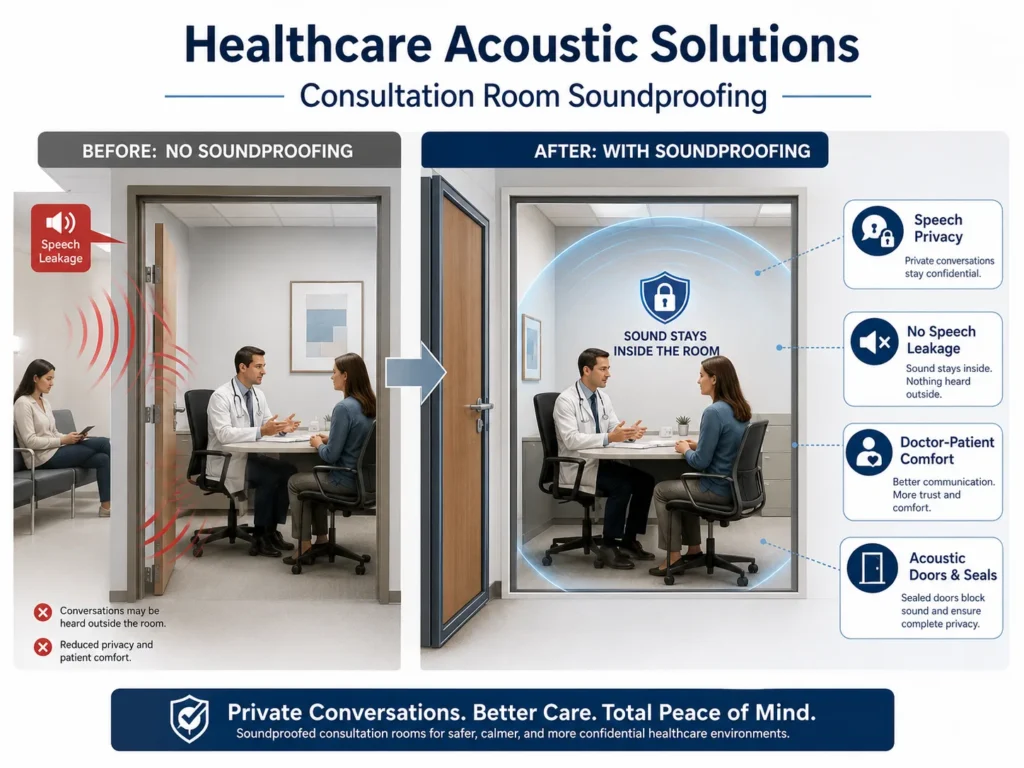
In a clinic, a patient sitting outside should not clearly hear the doctor discussing another patient’s medical condition. With proper consultation room soundproofing, acoustic doors, sealed gaps, wall treatment, and ceiling absorption, speech leakage can be reduced.
Healthcare Acoustic Solutions for Hospitals, Clinics & Consultation Rooms
Healthcare spaces need different acoustic solutions depending on the room type. A reception area has different sound problems than a doctor’s cabin, ICU, or diagnostic room.
The goal is not to make the room fully silent. The goal is to control sound so the space feels calm, private, and clear.
Common Noise Problems in Hospitals and Clinics
1. Echo in Waiting Areas
Large waiting areas often have hard floors, glass walls, gypsum ceilings, and metal furniture. These surfaces reflect sound.
This creates:
- Echo
- Loud conversations
- Poor comfort
- More stress for patients
2. Poor Speech Privacy in Consultation Rooms
In many clinics, conversations inside the doctor’s room can be heard outside. This affects patient trust and privacy.
Common reasons include:
- Thin partitions
- Gaps under doors
- Untreated ceilings
- Shared walls
- Poor room layout
3. Noise Transfer Between Rooms
Sound can travel through walls, doors, ceiling voids, ducts, and gaps.
This is common in:
- Doctor cabins
- Dental clinics
- Therapy rooms
- Diagnostic rooms
- Counselling rooms
- Patient rooms
4. Equipment and Footstep Noise
Hospitals have constant movement. Trolleys, footwear, machines, alarms, and HVAC systems add to the noise level.
Without proper healthcare noise control, these sounds can disturb patients and staff.
5. No Acoustic Planning During Interior Design
Many healthcare interiors focus only on appearance, lighting, and hygiene. Acoustics are added later as a correction.
This often increases cost and reduces effectiveness.
Pro Tip: Plan acoustics at the design stage. It is easier, cleaner, and more cost-effective than fixing noise problems after the clinic is complete.
Where Acoustic Treatment Is Needed in Healthcare Spaces
1. Doctor Consultation Rooms
A consultation room needs both clarity and privacy. The doctor and patient should hear each other clearly, but people outside should not hear the conversation.
Best solutions:
- Acoustic wall panels
- Sound-rated partitions
- Door sealing
- Acoustic ceiling treatment
- Soft flooring or noise-reducing flooring
- Proper HVAC noise control
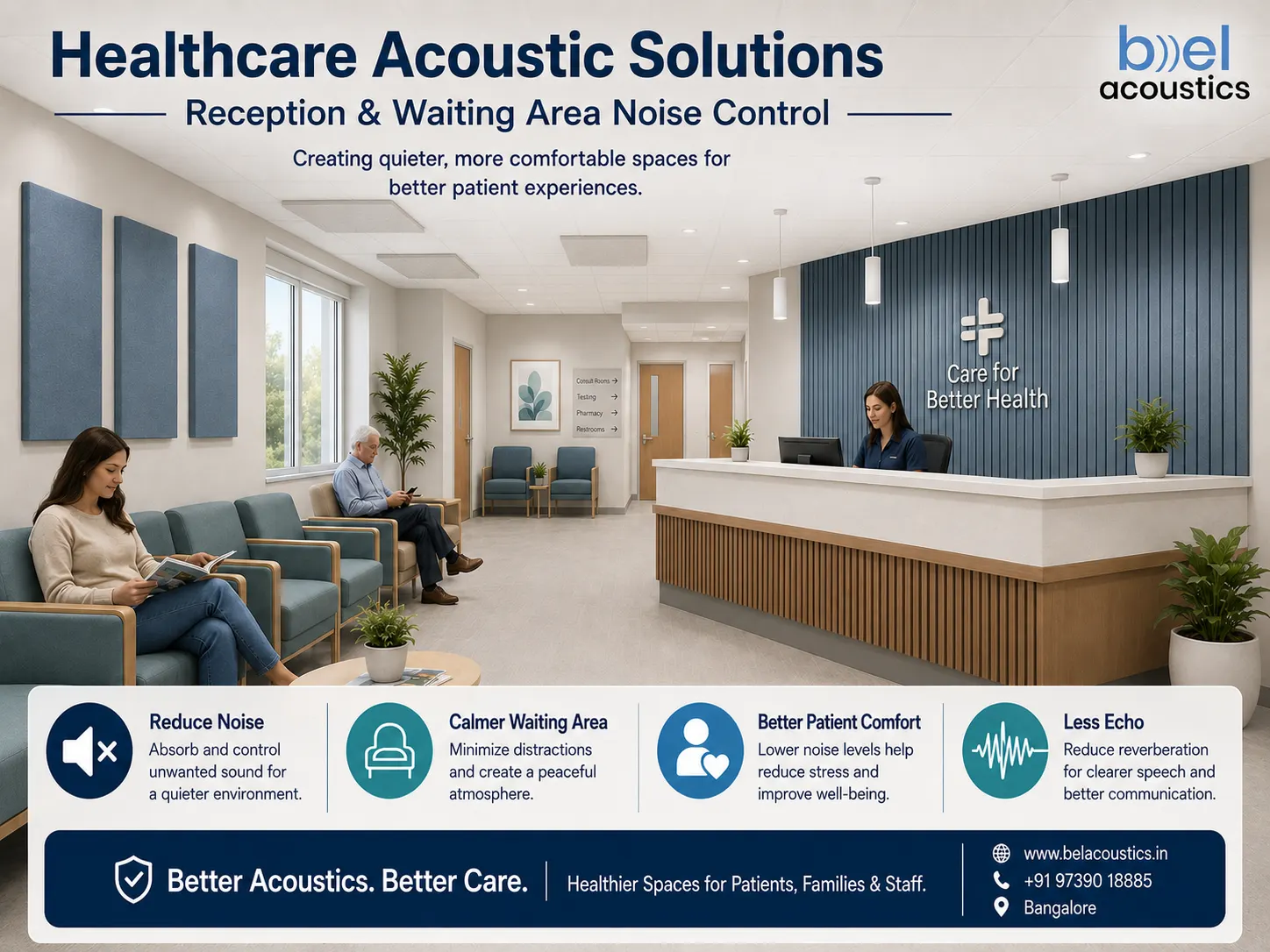
2. Clinic Reception and Waiting Areas
Waiting areas often become noisy because many people speak at the same time.
Best solutions:
- Ceiling acoustic panels
- Wall acoustic panels
- Fabric-wrapped panels
- Acoustic baffles
- Soft seating
- Sound-absorbing finishes
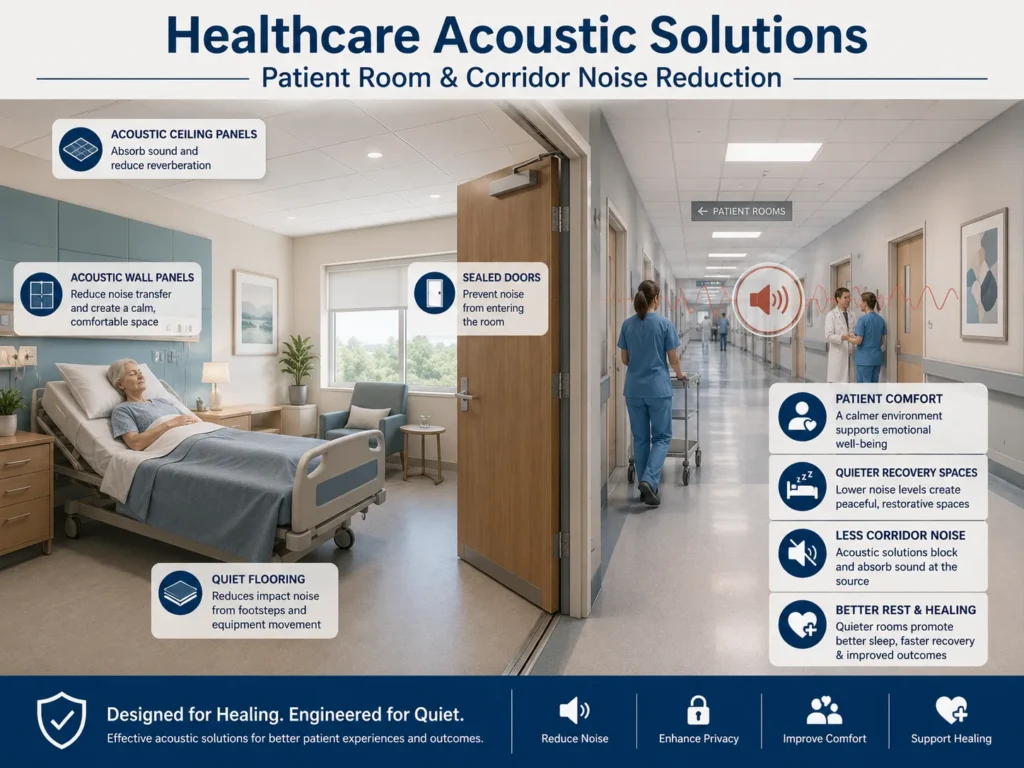
3. Patient Rooms
Patients need rest. Noise from corridors, nurse stations, equipment, and nearby rooms can disturb recovery.
Best solutions:
- Wall insulation
- Acoustic doors
- Sealed room gaps
- Ceiling absorption
- Quiet flooring
- Controlled corridor noise
4. ICU and Recovery Rooms
ICUs need a very controlled sound environment. Alarms, staff movement, and medical equipment can make the space stressful.
Best solutions:
- High-performance acoustic ceiling
- Noise control around equipment
- Sound-absorbing wall finishes
- Door and partition sealing
- Better layout planning
5. Dental Clinics
Dental clinics have special noise challenges due to drills, suction equipment, compressors, and treatment chairs.
Best solutions:
- Soundproof partitions
- Acoustic doors
- Ceiling absorption
- Equipment room isolation
- Wall acoustic treatment
6. Therapy and Counselling Rooms
Privacy is very important in therapy rooms. Patients must feel safe when speaking.
Best solutions:
- Consultation room soundproofing
- Acoustic wall panels
- Sealed doors
- Sound masking where suitable
- Room-to-room sound insulation
7. Diagnostic and Testing Rooms
Ultrasound rooms, audiology rooms, scanning rooms, and testing spaces need controlled noise levels.
Best solutions:
- Acoustic insulation
- Soundproof doors
- Low-noise HVAC planning
- Controlled reverberation
- Sound isolation from corridors
Best Acoustic Solutions for Hospitals and Clinics
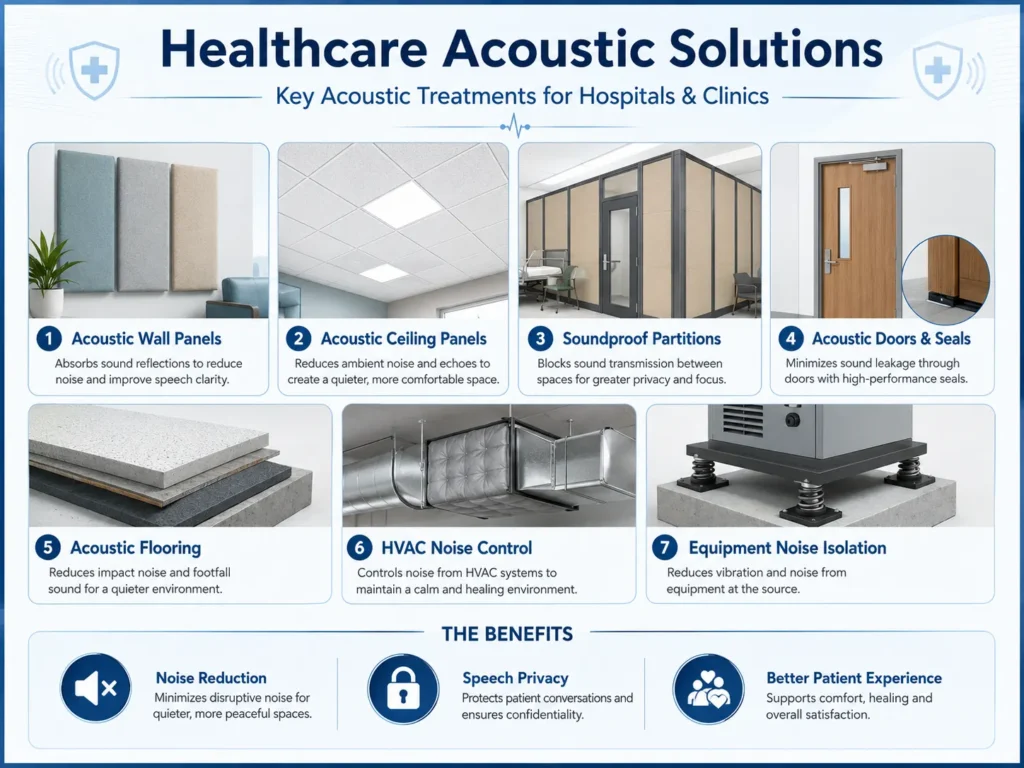
1. Acoustic Wall Panels
Acoustic panels for hospitals help absorb sound and reduce echo. They are ideal for consultation rooms, waiting areas, corridors, and staff rooms.
They can be made in different finishes such as:
- Fabric finish
- Wooden grooved finish
- PET acoustic panels
- Perforated acoustic panels
- Custom printed panels
Best Use Areas
- Waiting rooms
- Doctor cabins
- Reception areas
- Therapy rooms
- Meeting rooms
- Hospital admin offices
Pro Tip: Choose easy-to-clean and durable acoustic finishes for medical spaces.
2. Acoustic Ceiling Treatment
The ceiling is often the largest untreated surface in a clinic or hospital. Treating the ceiling can reduce overall noise levels.
Common options include:
- Acoustic ceiling tiles
- Hanging baffles
- Ceiling clouds
- Perforated ceiling systems
- Fabric acoustic ceiling panels
Best Use Areas
- Waiting areas
- Reception counters
- Patient rooms
- Corridors
- Consultation rooms
- Nurse stations
3. Consultation Room Soundproofing
Consultation room soundproofing is important for patient privacy. It helps stop speech from leaking outside the room.
Key steps include:
- Add sound-rated wall partitions
- Seal gaps around doors
- Use acoustic doors if needed
- Treat ceilings and wall surfaces
- Avoid shared open ceiling voids
- Control HVAC sound paths
Real-World Example
If a doctor’s cabin has a false ceiling that is open above the partition, sound can travel over the wall through the ceiling void. In this case, only adding wall panels will not solve the problem. The partition must continue up to the slab or include proper sound barriers above the ceiling.
4. Door Sealing and Acoustic Doors
Doors are one of the weakest points in medical room acoustics.
Even a small gap under the door can allow speech to pass outside.
Solutions include:
- Drop-down door seals
- Perimeter door seals
- Solid-core doors
- Acoustic-rated doors
- Proper door frame sealing
Best Use Areas
- Doctor rooms
- Counselling rooms
- Patient rooms
- Procedure rooms
- Diagnostic rooms
5. Soundproof Partitions
Many clinics use lightweight partitions. These may look good but may not block sound properly.
For better clinic soundproofing, use partitions with:
- Multiple board layers
- Acoustic insulation inside
- Air gaps
- Proper sealing
- Full-height construction up to slab level
Best Use Areas
- Multi-doctor clinics
- Dental clinics
- Therapy centres
- Diagnostic centres
- Hospital cabins
6. Acoustic Flooring Solutions
Footstep noise, trolley movement, and chair dragging can disturb patients.
Useful flooring options include:
- Carpet tiles for admin areas
- Vinyl flooring with acoustic backing
- Rubber flooring
- Underlay systems
- Anti-vibration flooring in special areas
Best Use Areas
- Corridors
- Patient rooms
- Waiting lounges
- Staff areas
- Therapy rooms
7. HVAC and Equipment Noise Control
Air-conditioning ducts, exhaust fans, compressors, and medical equipment can create constant background noise.
Solutions include:
- Duct silencers
- Vibration isolators
- Acoustic lining
- Equipment room isolation
- Low-noise diffuser selection
- Proper machine placement
Pro Tip: Do not ignore HVAC noise. Even a beautifully treated room can feel noisy if the AC system is loud.
Step-by-Step Healthcare Acoustic Design Process
Step 1: Identify the Noise Problem
First, understand what type of noise issue exists.
Ask:
- Is there too much echo?
- Is speech leaking outside?
- Is outside noise entering the room?
- Is equipment noise disturbing patients?
- Is the waiting area too loud?
Step 2: Study the Room Type
Different healthcare rooms need different acoustic targets.
For example:
- Consultation room: speech privacy
- Waiting area: noise reduction
- Patient room: rest and comfort
- Dental room: machine noise control
- Therapy room: confidentiality
Step 3: Check Sound Paths
Sound can travel through:
- Doors
- Walls
- Ceiling voids
- Floors
- Glass partitions
- Ducts
- Electrical openings
- Gaps and cracks
Step 4: Select the Right Acoustic Materials
Choose materials based on the problem.
For echo control:
- Acoustic panels
- Ceiling tiles
- Baffles
- Soft finishes
For sound blocking:
- Soundproof partitions
- Acoustic doors
- Wall insulation
- Door seals
For vibration control:
- Anti-vibration pads
- Equipment isolation
- Floating floor systems
Step 5: Install with Proper Detailing
Good material can fail if installation is poor.
Important details include:
- No open gaps
- Sealed joints
- Correct panel placement
- Proper partition height
- No untreated ceiling paths
- Correct door sealing
Step 6: Test the Result
After installation, check if the room performs well.
Test for:
- Speech privacy
- Echo reduction
- Noise transfer
- Patient comfort
- Staff feedback
Acoustic Treatment vs Soundproofing: What Is the Difference?
Many people use these words together, but they are different.
Acoustic Treatment
Acoustic treatment improves sound quality inside a room.
It helps with:
- Echo control
- Speech clarity
- Comfort
- Noise absorption
Example: Adding acoustic panels in a waiting room.
Soundproofing
Soundproofing stops sound from entering or leaving a room.
It helps with:
- Privacy
- Room-to-room noise control
- Outside noise reduction
- Confidential conversations
Example: Soundproofing a doctor consultation room so conversations cannot be heard outside.
Pro Tip: Most healthcare spaces need both acoustic treatment and soundproofing.
Common Mistakes in Hospital and Clinic Acoustics
Mistake 1: Using Only Foam Panels
Foam may reduce some echo, but it does not provide strong soundproofing. It is not enough for patient privacy.
Mistake 2: Ignoring Door Gaps
A good wall will not work if the door has large gaps. Sound will escape through the weakest point.
Mistake 3: Treating Only One Wall
Sound reflects from multiple surfaces. A proper acoustic plan considers walls, ceiling, flooring, doors, and layout.
Mistake 4: Using Glass Without Acoustic Planning
Glass partitions look premium but can reflect sound and reduce privacy if not designed correctly.
Mistake 5: Not Treating the Ceiling Void
If partitions stop at the false ceiling, speech may travel above the ceiling and enter the next room.
Mistake 6: Choosing Materials Only by Appearance
Healthcare acoustic materials should be selected for performance, durability, hygiene, and design.
Best Areas to Prioritize First
If the budget is limited, start with the most sensitive areas.
- Doctor consultation rooms
- Reception and waiting areas
- Therapy or counselling rooms
- Patient rooms
- Dental or procedure rooms
- Nurse stations
- Corridors
How Acoustic Design Improves Patient Privacy
Patient privacy is one of the biggest reasons to invest in healthcare acoustics.
In clinics and hospitals, private details are discussed every day, such as:
- Symptoms
- Medical history
- Test results
- Prescriptions
- Personal health concerns
- Billing information
If these conversations are clearly heard outside, it affects patient trust.
Best Ways to Improve Patient Privacy Acoustics
- Use soundproof partitions
- Seal doors properly
- Add acoustic ceiling barriers
- Install wall acoustic systems
- Avoid placing waiting chairs near consultation doors
- Use soft background sound where suitable
- Plan reception counters away from seating zones
Clinic Acoustic Design: Practical Layout Tips
A good layout can reduce noise before materials are even added.
Smart Planning Ideas
- Keep consultation rooms away from noisy reception areas
- Avoid placing doctor cabins back-to-back without insulation
- Use buffer zones between public and private areas
- Keep equipment rooms away from patient rooms
- Use soft finishes in waiting areas
- Avoid long empty corridors with hard surfaces
- Place noisy areas near service zones, not patient zones
Example
In a small clinic, the waiting chairs should not directly face the consultation room door. A small acoustic partition or layout shift can improve privacy and comfort.
Recommended Acoustic Materials for Healthcare Spaces
For Walls
- Fabric acoustic panels
- PET acoustic panels
- Perforated wooden acoustic panels
- Sound-insulated gypsum partitions
- Custom printed acoustic panels
For Ceilings
- Acoustic ceiling tiles
- Ceiling clouds
- Hanging acoustic baffles
- Perforated ceiling systems
For Doors
- Solid-core doors
- Acoustic doors
- Door bottom seals
- Perimeter seals
For Floors
- Acoustic vinyl
- Rubber flooring
- Carpet tiles
- Acoustic underlay
For Equipment
- Anti-vibration pads
- Duct silencers
- Acoustic enclosures
- Machine room isolation
Pro Tips for Better Healthcare Noise Control
- Always seal gaps before adding more panels.
- Use acoustic panels for echo, not for full soundproofing.
- Treat ceiling voids in consultation rooms.
- Choose materials that match healthcare hygiene needs.
- Keep noisy machines away from patient spaces.
- Avoid too many hard reflective surfaces.
- Plan acoustic treatment during interior design.
- Use professional acoustic measurement for large hospitals.
- Office Acoustic Solutions for Open Workspaces
- Auditorium Acoustic Design
- Acoustic Panels for Commercial Spaces
- Soundproofing Solutions for Villas
- Home Theatre Acoustic Design
- Acoustic Treatment for Conference Rooms
- Noise Control Solutions for Commercial Interiors
Suggested anchor texts:
- office acoustic solutions
- acoustic panels for commercial spaces
- soundproofing solutions
- acoustic design for conference rooms
- noise control solutions
FAQs: Healthcare Acoustic Solutions for Hospitals and Clinics
1. What are healthcare acoustic solutions?
Healthcare acoustic solutions are sound control methods used in hospitals, clinics, consultation rooms, patient rooms, and waiting areas. They reduce echo, noise transfer, and speech leakage to improve privacy, comfort, and communication.
2. Why is soundproofing important in consultation rooms?
Consultation room soundproofing protects patient privacy. It prevents private medical conversations from being clearly heard outside the room.
3. What is the best acoustic treatment for clinic waiting areas?
The best treatment usually includes acoustic ceiling panels, wall panels, soft seating, and layout planning. These reduce echo and make the waiting area calmer.
4. Do acoustic panels make a room soundproof?
No. Acoustic panels reduce echo inside a room, but they do not fully block sound from leaving or entering. For soundproofing, you need sound-rated walls, sealed doors, and proper insulation.
5. How can hospitals reduce patient room noise?
Hospitals can reduce patient room noise by using acoustic doors, sealed partitions, sound-absorbing ceilings, quiet flooring, equipment isolation, and better corridor noise control.
6. What is speech privacy in clinics?
Speech privacy means people outside a room cannot clearly understand conversations happening inside. It is important for doctor cabins, counselling rooms, billing counters, and diagnostic spaces.
7. Which areas in hospitals need acoustic treatment the most?
The most important areas are consultation rooms, patient rooms, ICUs, waiting areas, nurse stations, therapy rooms, dental rooms, and diagnostic rooms.
8. Is clinic soundproofing expensive?
The cost depends on room size, wall type, door quality, ceiling design, and privacy requirement. Basic echo control is usually lower cost, while full soundproofing needs more detailed work.
9. Can acoustic solutions be added to an existing clinic?
Yes. Existing clinics can be improved with acoustic panels, ceiling treatment, door seals, partitions, and layout changes. However, soundproofing is easier when planned during construction.
10. What is the difference between hospital acoustics and normal room acoustics?
Hospital acoustics focus on privacy, patient comfort, staff communication, sleep quality, and hygiene-friendly materials. Normal room acoustics may only focus on echo control or sound quality.
Conclusion
Good healthcare design is not only about clean interiors, lighting, and equipment. Sound also plays a major role in patient comfort, privacy, and trust.
With the right healthcare acoustic solutions for hospitals, clinics, and consultation rooms, you can reduce noise, improve speech clarity, protect patient privacy, and create a calm healing environment.
If you are planning a hospital, clinic, diagnostic centre, dental clinic, or consultation room, invest in acoustic design from the beginning.
A quieter healthcare space feels more professional, more private, and more caring.
Need expert acoustic solutions for your healthcare space? Contact BEL Acoustics for consultation room soundproofing, hospital noise control, acoustic panels, and complete clinic acoustic design solutions.
📞 Call / WhatsApp: +91 97390 18885
📧 Email: info@belacoustics.in
📍 Location: Bengaluru, India
🗺 Find us on Google Maps: https://g.co/kgs/ZKWQbuK