
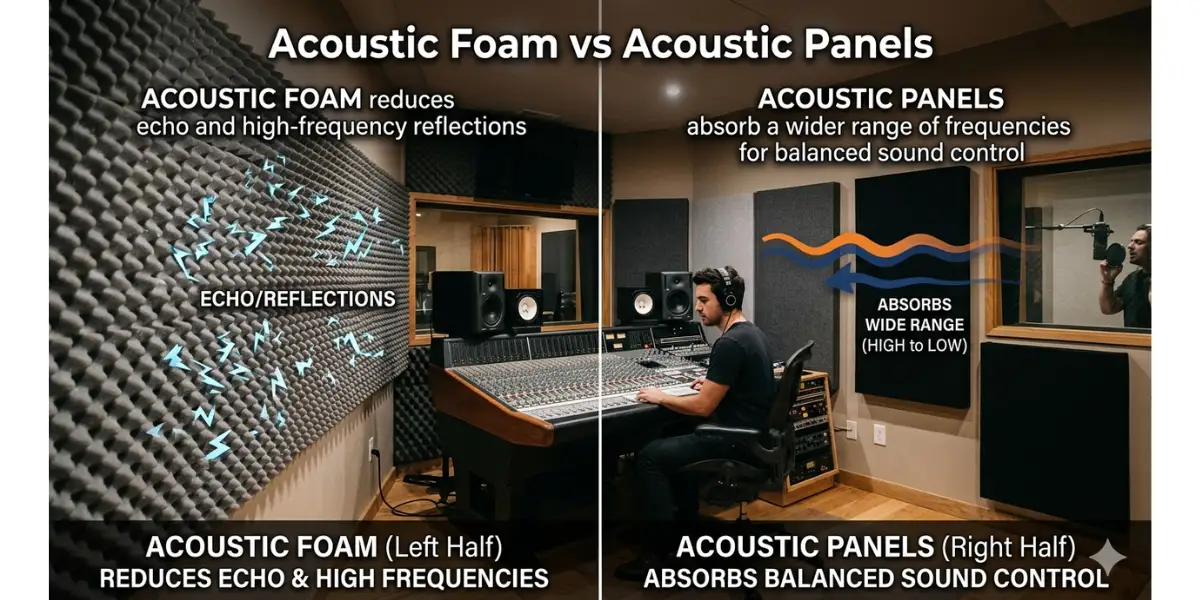

Acoustic foam and acoustic panels both improve studio sound, but they serve different purposes. Acoustic foam mainly reduces echo and high-frequency reflections, while acoustic panels absorb a wider range of frequencies for balanced sound control. For recording studios, acoustic panels generally provide better overall sound treatment.
Table of Contents
- Introduction
- What is Acoustic Foam?
- What are Acoustic Panels?
- Acoustic Foam vs Panels for studios: Key Differences
- Which is Better for Recording Studios?
- How to Choose the Right Acoustic Treatment
- Advanced Acoustic Treatment Solutions
- Common Mistakes to Avoid
- Pro Tips from Acoustic Experts
- FAQs
- Conclusion
Introduction
If you’re building or improving a recording studio, one of the most common questions you’ll face is:
Should you use acoustic foam or acoustic panels?
Many beginners assume these two are the same. In reality, they serve different purposes in sound treatment and acoustic control.
Poor acoustics can cause problems like:
- Echo and reverb
- Muddy recordings
- Unbalanced sound
- Poor mixing accuracy
Whether you’re a podcaster, musician, YouTuber, or home studio owner, choosing the right acoustic treatment can dramatically improve your audio quality.
In this guide, we’ll break down acoustic foam vs acoustic panels, explain how they work, and help you decide which solution is best for your recording studio.
What is Acoustic Foam?
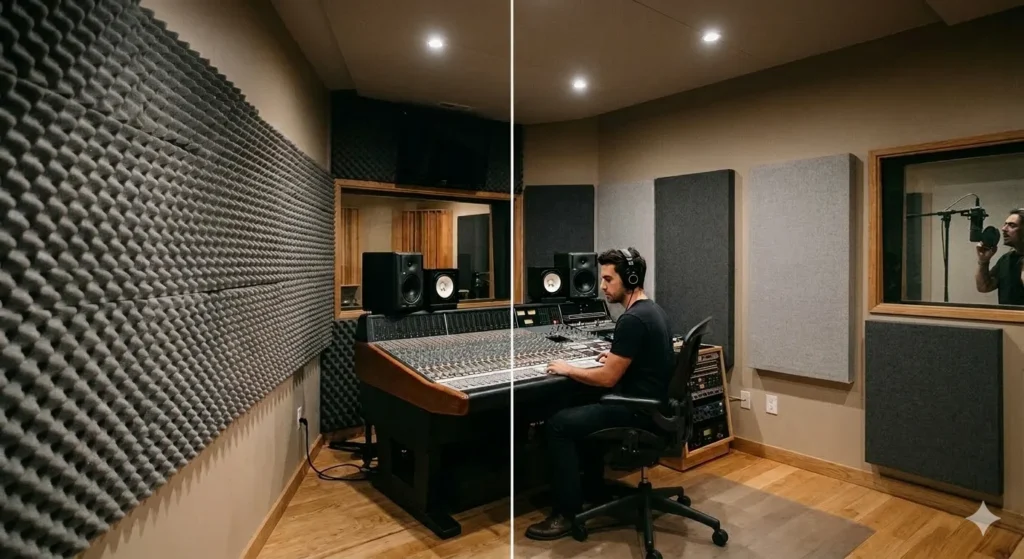
Acoustic foam is a lightweight sound treatment material designed to reduce echo and high-frequency reflections in a room.
You’ve probably seen these pyramid or wedge-shaped foam panels in studios and podcast rooms.
Key Features of Acoustic Foam
- Made from polyurethane foam
- Designed to absorb mid and high frequencies
- Lightweight and easy to install
- Affordable for beginners
What Acoustic Foam Does
Acoustic foam helps with:
- Reducing echo
- Minimizing sound reflections
- Improving speech clarity
- Controlling flutter echo
However, foam does not block sound and is less effective at absorbing low frequencies (bass).
What are Acoustic Panels?
Acoustic panels are high-density sound absorption panels designed to control a broader range of frequencies.
They are commonly used in:
- Recording studios
- Home theaters
- Podcast rooms
- Office spaces
- Conference rooms
Materials Used in Acoustic Panels
Acoustic panels are typically made from:
- Fiberglass
- Mineral wool
- Polyester fiber
- Wood-backed absorbers
Benefits of Acoustic Panels
Acoustic panels help with:
- Controlling bass frequencies
- Reducing room reflections
- Improving sound clarity
- Creating balanced acoustics
Because they absorb both mid and low frequencies, they are more effective for professional studio environments.
![Printed Matte Polyester Fabric [AT]](https://belacoustics.in/wp-content/uploads/2025/08/Untitled-design-88.webp)
Acoustic Foam vs Panels for Studios : Key Differences
| Feature | Acoustic Foam | Acoustic Panels |
|---|---|---|
| Material | Polyurethane foam | Fiberglass / Mineral wool |
| Frequency absorption | High frequencies | Low, mid, and high |
| Sound quality improvement | Moderate | High |
| Cost | Cheaper | Higher |
| Professional studio use | Limited | Widely used |
| Installation | Easy | Moderate |
Summary
- Foam = Echo control
- Panels = Professional acoustic treatment
Which is Better for Recording Studios?
For most recording studios, acoustic panels are the better choice.
Reasons Panels Perform Better
- Better frequency absorption
Panels absorb low, mid, and high frequencies. - Balanced sound environment
Essential for mixing and mastering. - Professional sound quality
Used in most commercial studios. - Improved vocal recordings
Reduces room coloration.
When Acoustic Foam Works
Acoustic foam can still be useful for:
- Small home studios
- Podcast rooms
- Vocal booths
- Budget setups
Many studios actually use both foam and panels together.
How to Choose the Right Acoustic Treatment
When choosing between acoustic foam and panels, consider the following factors.
1. Room Size
Small rooms benefit more from high-density acoustic panels.
Foam alone often cannot control reflections properly.
2. Recording Type
Different recording setups require different treatments.
| Recording Type | Recommended Treatment |
|---|---|
| Podcasting | Foam + panels |
| Music recording | Panels |
| Voiceover | Foam + bass traps |
| Mixing studio | Panels + bass traps |
3. Budget
If you’re starting out:
- Foam = budget-friendly option
- Panels = long-term investment
4. Frequency Problems
If your studio has:
- Boomy bass
- Muddy sound
Then you need acoustic panels or bass traps, not foam.
Advanced Acoustic Treatment Solutions
Professional studios often combine multiple acoustic treatments.
1. Bass Traps
Bass traps absorb low-frequency buildup in room corners.
They are essential for accurate mixing.
2. Diffusers
Diffusers scatter sound reflections rather than absorbing them.
Benefits include:
- Natural sound
- Balanced reflections
- Better stereo imaging
3. Hybrid Panels
Some modern studios use hybrid acoustic panels that combine:
- Absorption
- Diffusion
This improves both clarity and room ambience.
Common Mistakes to Avoid
Many people make these mistakes when treating a studio.
1. Covering Every Wall with Foam
Too much foam can make a room sound dead and unnatural.
2. Ignoring Bass Problems
Low frequencies are the biggest problem in small studios.
Foam alone cannot solve this.
3. Poor Panel Placement
Acoustic panels must be placed at reflection points, not randomly.
Common placement areas include:
- Side walls
- Behind speakers
- Behind the recording position
- Ceiling reflection points
3. Poor Panel Placement
Acoustic panels must be placed at reflection points, not randomly.
Common placement areas include:
- Side walls
- Behind speakers
- Behind the recording position
- Ceiling reflection points
Pro Tips (Most Websites Don’t Tell You)
1. Use the Mirror Test
Sit at your mixing position and have someone move a mirror along the wall.
Where you see the speakers in the mirror = reflection point for panels.
2. Start with Corner Bass Traps
Before adding foam or panels, install corner bass traps.
This fixes the biggest acoustic issue first.
3. Ceiling Treatment is Often Ignored
Adding a ceiling cloud panel above your desk dramatically improves sound.
4. Don’t Over-Treat the Room
Aim for balanced absorption, not complete silence.
Professional studios combine:
- absorption
- diffusion
- reflection control
FAQs
Acoustic foam can help reduce echo and reflections in small recording spaces. However, it mainly absorbs high frequencies and may not control bass effectively.
No, acoustic panels do not soundproof a room. They improve sound quality inside the room but do not block sound from escaping.
Most small studios require 6–12 acoustic panels, depending on room size and reflection points.
Yes, many studios use both together. Foam helps reduce echo while panels improve overall sound balance.
Acoustic panels should be placed at first reflection points, behind speakers, and sometimes on the ceiling.
Conclusion
Both acoustic foam and acoustic panels can improve studio sound, but they serve different roles.
- Acoustic foam is useful for reducing echo and high-frequency reflections.
- Acoustic panels provide broader sound absorption and professional acoustic treatment.
For most recording studios, acoustic panels are the better investment because they create a balanced and accurate listening environment.
If you’re building a studio setup, the best solution is often a combination of acoustic panels, bass traps, and selective foam treatment.
This approach delivers the clean, professional sound every recording studio needs.
Contact US
📞 Call / WhatsApp: +91 97390 18885
📧 Email: info@belacoustics.in
📍 Location: Bengaluru, India
🗺 Find us on Google Maps: https://g.co/kgs/ZKWQbuK